Overview
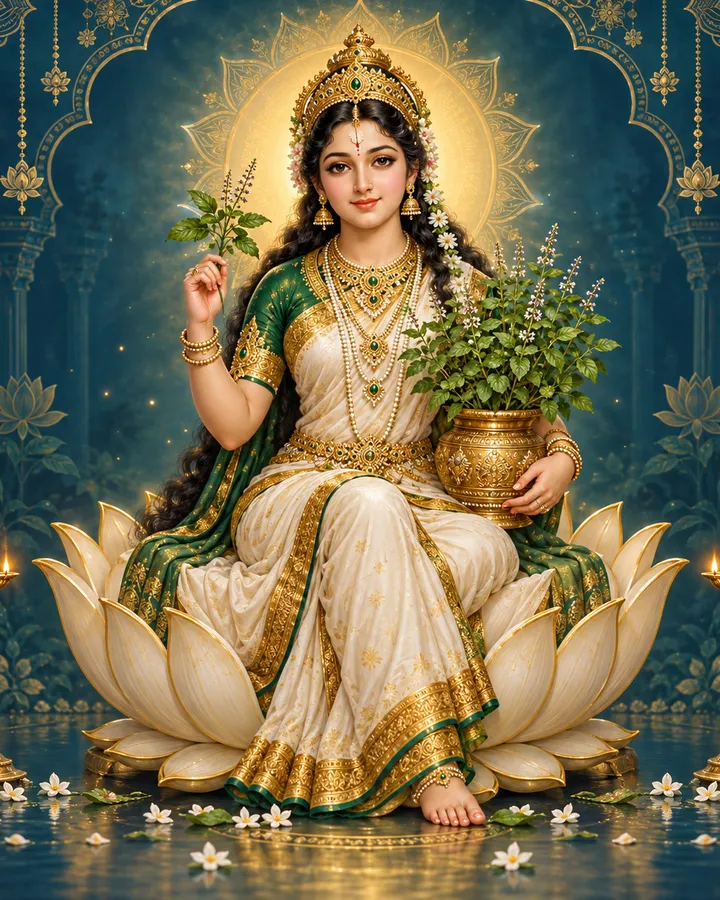
Tulsi (तुलसी, Tulasī) is worshipped in Hindu households as a living plant, holy basil, rather than through the statue or painted image typical of most goddesses — a genuinely distinctive form of worship among major Hindu deities. She is closely and specifically associated with Vishnu, worshipped in his Shaligram stone form as her consort, and her devotion is strongest within Vaishnava tradition.
This page covers the two separate legends behind her transformation into a plant, the living practice of household Tulsi worship, and Tulsi Vivah, her yearly ritual marriage.
Two legends, not one
Hindu tradition tells two distinct, textually separate stories of how Tulsi came to be a plant, and this page does not merge them into one narrative.
The Lakshmi-Tulasi legend, told in the Devi Bhagavata Purana, describes Tulasi as a manifestation of Lakshmi, born to King Dharmadhvaja, who performs penance at Badrinath to win Vishnu as her husband. Brahma requires that she first marry the daitya Shankhachuda; after Shiva kills him, Vishnu deceives Tulasi by assuming Shankhachuda’s form. On realizing the deception, she moves to curse Vishnu; he reveals himself and, in recompense, grants her a place in Vaikuntha and promises that her body will become the river Gandaki and her hair the Tulasi plant.
The Vrinda-Jalandhara legend, told across the Skanda, Padma, and Shiva Puranas, is a separate story. Vrinda, daughter of the asura Kalanemi, marries the demon Jalandhara; her unbroken chastity magically protects him from defeat, so the gods, unable to overcome him by force, send Vishnu to deceive her by impersonating her husband. The deception breaks her chastity, allowing Shiva to kill Jalandhara; grief-stricken, Vrinda curses Vishnu — in some versions, to be turned to stone, offered as the origin of the Shaligram stones through which Vaishnava devotees worship him — before ending her own life. Vishnu then transforms her into the Tulasi plant and promises to marry her in that Shaligram form, the basis of Tulsi Vivah.
Across both legends, the consistent throughline is her marriage to Vishnu as Shaligram — the reason Tulsi leaves are placed on Shaligram stones in daily Vaishnava worship to this day.
Worship as a living plant
Tulsi is grown in most Vaishnava households in a dedicated pedestal, the Tulsi Vrindavan, usually placed in a courtyard or near the entrance. Every part of the plant — leaves, stem, root, seed, and oil — is treated as sacred, and Vaishnava devotees traditionally wear japa malas strung from its wood, sometimes called “bearers of the tulsi” as a mark of their devotion. Daily and weekly household ritual, watering the plant, lighting a lamp beside it, and circumambulating it, with particular emphasis on Tuesdays and Fridays, is the most consistent and widespread living expression of her worship — arguably more so than any temple tradition.
Her strong association with Vishnu also defines her exclusion elsewhere: she is largely absent from Shakta worship, where her scent is traditionally held to displease the Devi, and from offerings made to Hanuman, owing to his celibate status. Her place within Shaiva worship of Shiva is inconsistent — some traditions accept Tulsi as an offering, while others prescribe bael (bilva) leaves instead and exclude her specifically.
Tulsi Vivah
Tulsi Vivah, the ceremonial wedding of the Tulsi plant to Vishnu — represented by a Shaligram stone, or sometimes an image of Krishna or Rama — is observed between Prabodhini Ekadashi and Kartik Purnima, typically in November. It marks the end of Chaturmasya, the four-month period, and the traditional opening of the Hindu marriage season.
In scripture
- Rig Veda — the earliest textual mentions of the tulsi plant itself, well predating the developed goddess-legend; the personified Vrinda/Tulasi narrative is a later Puranic-era elaboration, not a claim of equal antiquity.
- Devi Bhagavata Purana — source of the Lakshmi-Tulasi legend.
- Skanda Purana, Padma Purana, and Shiva Purana — sources of the Vrinda-Jalandhara legend.
Iconography at a glance
Major temple
Vrinda Kund
Near Nandgaon, Barsana, Mathura district, Uttar Pradesh, India
A shrine and tank dedicated specifically to Vrinda Devi, the personification of Tulsi.
Open in Maps ↗Worth knowing
- Tulsi is worshipped as a living plant, typically grown in a special pedestal called a Tulsi Vrindavan near a home's entrance or courtyard, rather than through a statue or painted image the way most goddesses are.
- Two separate Puranic legends — the Lakshmi-Tulasi story and the Vrinda-Jalandhara story — both end with the goddess transformed into the Tulsi plant and wedded to Vishnu; they are distinct traditions, not one shared story.
- Tulsi Vivah, her ritual marriage to Vishnu in his Shaligram stone form, is a widely observed festival marking the end of the four-month Chaturmasya period and the opening of the Hindu wedding season.
- Vaishnava devotees traditionally wear japa malas made from Tulsi wood.
- She is largely excluded from Shakta worship and from offerings to Hanuman under specific textual and traditional prohibitions, while her status within Shaiva practice is inconsistent across regions.