Overview
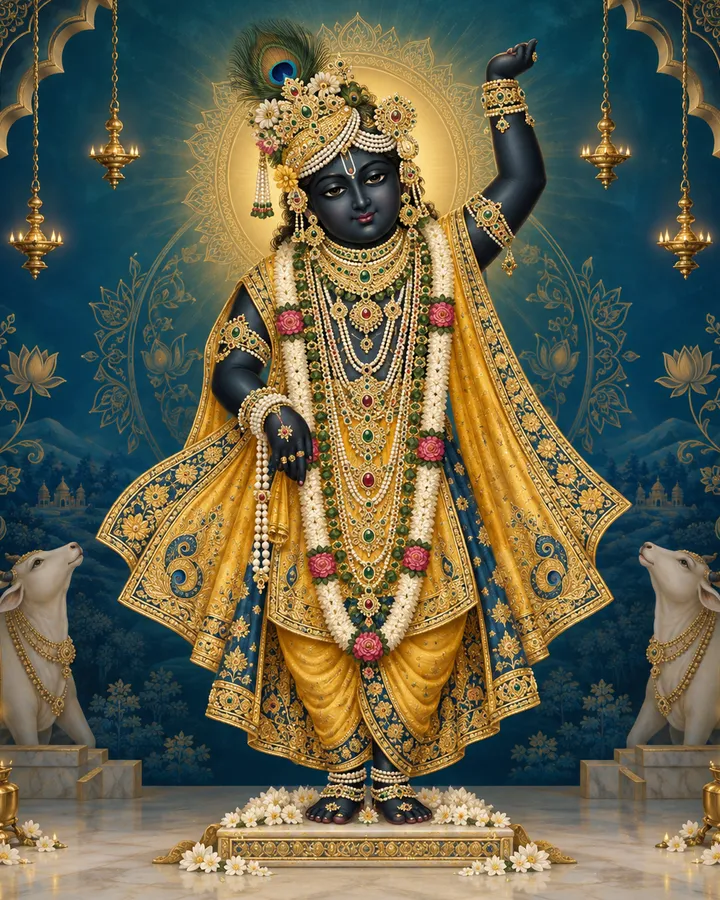
Shrinathji (श्रीनाथजी, Śrīnāthjī) is Krishna worshipped specifically as a seven-year-old child, shown lifting Govardhan Hill on the little finger of his left hand to shelter the people and cattle of Vraj from a storm sent by Indra. He is the presiding image of Pushtimarg, “the path of grace,” a Vaishnava tradition founded by the philosopher-saint Vallabhacharya, and his principal temple at Nathdwara, Rajasthan is that tradition’s central seat.
Iconography
The image is carved in bas-relief from a single block of black stone, left arm raised overhead in the act of lifting Govardhan, right hand resting at the waist. A diamond is traditionally placed beneath the lower lip, and a U-shaped tilak marks the forehead, read within the tradition as the imprint of Radha’s foot. The surrounding stone also carries figures worked into the same relief — two cows, a lion, a snake, two peacocks, a parrot, and three sages. Devotees dress and decorate the image in silk, and its clothing changes frequently — sources describe this happening as often as several times a week, alongside a schedule of eight formal darshans, or viewings, each day, from Mangala at dawn through to Shayan at bedtime.
Origin at Govardhan
Devotional tradition holds that the image self-manifested from the rock of Govardhan Hill, and that Vallabhacharya received a vision directing him to find it and establish its worship there. This page treats that as the tradition’s own founding account rather than an independently verified historical claim, and does not assign a specific year to the image’s original appearance, since sources vary and do not agree on one.
The flight to Nathdwara
In the late 1660s, Aurangzeb’s Mughal administration undertook a campaign of temple destruction across the Mathura region, and the image was moved from Govardhan in secrecy, around 1669, ahead of that campaign — the nearby Keshav Dev temple at Mathura was itself demolished in 1670. What followed was a journey of several years: the image sheltered in Agra for roughly six months, then moved through Bundi, Kishangarh, and Chopasani near Jodhpur, with local rulers at each stop declining to offer it permanent shelter for fear of reprisal. Maharana Raj Singh I of Mewar eventually agreed to protect it, and in 1672 the image was permanently settled at the village of Sihad, renamed Nathdwara, “gateway of the Lord,” soon after — tradition holds that the cart carrying it sank axle-deep in mud at the spot and would move no further, taken as a sign the Lord had chosen his own resting place.
The temple and Pushtimarg worship
The temple built at Nathdwara from 1672 onward follows a haveli, or household, design rather than the conventional temple plan of shikhara and sanctum, with functional spaces for a kitchen, a jewelry chamber, and stores for the daily offerings the deity receives. In 1802, the image was briefly evacuated to Udaipur when Jaswant Rao Holkar’s forces threatened Nathdwara, later returning once the danger passed. Under the Nathdwara Temple Act of 1959, upheld by the Supreme Court in 1963 against a challenge from the temple’s hereditary Tilkayat family, the temple and its endowments are legally vested in the deity itself. Annakut, the day after Diwali, re-enacts Krishna’s lifting of Govardhan with an enormous offering of food and is celebrated with particular elaborateness at Nathdwara given the deity’s core identity; Janmashtami, Radhashtami, Holi, and Sharad Purnima are also major occasions. The temple’s tradition of seasonal costume and decoration change gave rise to Pichwai, a distinct style of painted or appliquéd textile hangings used as backdrops behind the image, recognized today as part of the Mewar school of Rajasthani painting.
In scripture
- Anubhashya — Vallabhacharya’s commentary on the Brahma Sutras, foundational to Pushtimarg philosophy.
- Subodhini — his commentary on the Bhagavata Purana.
- Chaurasi Vaishnavan ki Varta — hagiographic narratives of Vallabhacharya and his early disciples, compiled by later followers of the tradition.
Iconography at a glance
Major temple
Shrinathji Temple (Shrinathji ki Haveli)
Nathdwara, Rajsamand district, Rajasthan, India
Built from 1672 onward on the bank of the Banas River, following a haveli rather than conventional temple design; governed since 1959 under the Nathdwara Temple Act, which vests ownership of the temple and its endowments in the deity itself.
Open in Maps ↗Worth knowing
- Shrinathji depicts Krishna specifically as a seven-year-old child, at the moment of lifting Govardhan Hill on the little finger of his left hand to shelter the people and cattle of Vraj from a storm sent by Indra.
- The image was originally worshipped at Govardhan Hill near Mathura and was moved in secrecy around 1669, ahead of Aurangzeb's temple-destruction campaign in the region, reaching its permanent home at Nathdwara in 1672 after a journey through Agra, Bundi, Kishangarh, and Chopasani.
- Vallabhacharya, founder of the Pushtimarg tradition, is traditionally credited with revealing and establishing worship of the image at Govardhan; his son, Vitthalnathji, is credited with formally institutionalizing its worship at Nathdwara.
- The deity receives eight scheduled darshans (viewings) each day, from Mangala at dawn to Shayan at bedtime, and its clothing and decoration change frequently — a devotional practice that gave rise to Nathdwara's tradition of Pichwai, painted or appliquéd textile hangings changed seasonally as backdrops behind the image.
- Under the Nathdwara Temple Act of 1959, upheld by the Supreme Court in 1963, the temple and its endowments are legally vested in the deity Shrinathji itself, rather than in any individual or family.