

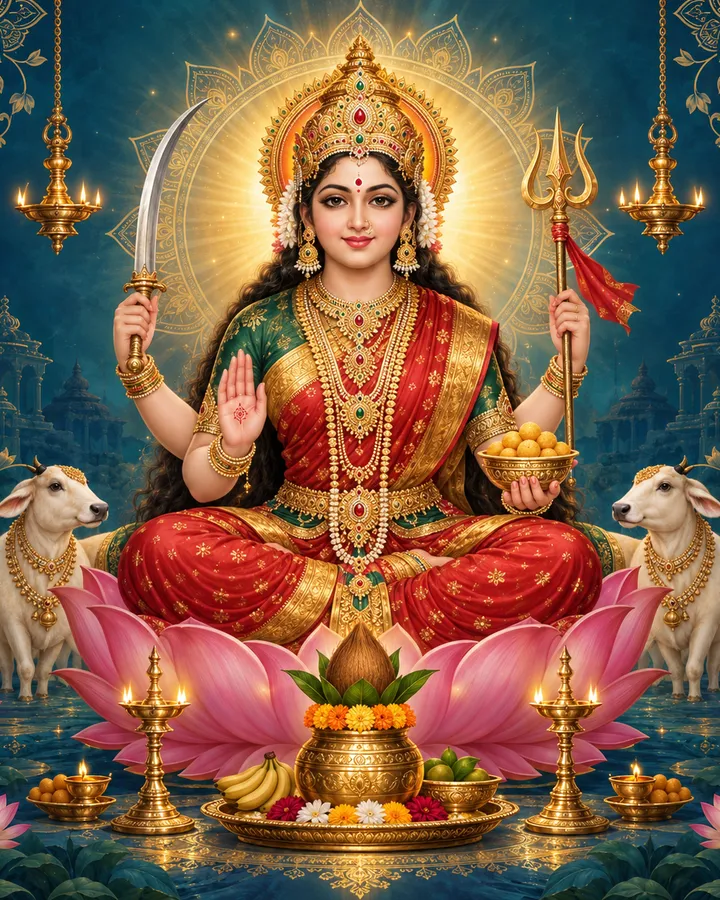
Overview
Santoshi Mata (संतोषी माता, Santoṣī Mātā), “Mother of Contentment,” is a Hindu folk goddess whose worship centers on a single defining practice, the Solah Shukrawar Vrat, a sixteen-Friday fast undertaken to secure her blessing. Unlike most goddesses covered on this site, her nationwide popularity is not ancient: it dates specifically to the 1975 Hindi film Jai Santoshi Maa, a fact this page treats directly rather than passing over, since it’s one of the more clearly documented instances of a new goddess entering mainstream Hindu devotion within living memory.
A goddess without a classical textual base
Santoshi Mata has essentially no substantial Puranic or classical scriptural basis — this is a fact about her, not a gap in this page’s research. What record exists of her before the twentieth century takes the form of vrata-katha, orally transmitted fasting-story pamphlets told mainly among women in domestic settings, rather than temple or Brahminical textual tradition. Her later, now-standard genealogy — daughter of Ganesha, born of his wives Riddhi and Siddhi, sister to his sons Shubh and Labha — comes specifically from the 1975 film’s screenplay, not from this earlier oral tradition, which did not associate her with Ganesha at all. This page states that origin plainly rather than presenting the film-era genealogy as if it were ancient scripture.
The 1975 film and her spread
Jai Santoshi Maa, directed by Vijay Sharma, is the documented primary mechanism by which Santoshi Mata became a nationally recognized goddess. Audiences reportedly treated screenings as devotional events in their own right: removing their shoes before entering theatres, and attending special women’s Friday matinee screenings tied directly to the Friday vrat the film promoted. It’s an unusually well-documented case of a single film functioning as a live vector for the spread of new deity worship in modern India, rather than simply popularizing an already-established cult.
Worship: the Solah Shukrawar Vrat
Her defining ritual, the sixteen-Friday fast, is observed for sixteen consecutive Fridays, or until a wish is granted. Puja is performed with flowers, incense, raw sugar (gur), and roasted chickpeas (chana) — this gur-chana offering is her most distinctive and consistent ritual detail. One meal is permitted on each fast day, and sour or bitter foods are specifically prohibited for its duration, an unusual rule compared to most other vrats. Devotees are also expected to avoid quarrels and cultivate harmony during the observance. The vrat concludes with an udyapan, a closing ceremony in which a festive meal is served to eight young boys.
Facts
Santoshi Mata does not have a large classical epithet-cluster or a firmly fixed vahana the way older goddesses do — her vehicle is described variably as a tiger, a cow, or a lotus seat depending on the depiction — consistent with a tradition that has not yet accumulated centuries of textual elaboration. Her practice, rather than an extensive mythology, remains her primary devotional footprint: for most devotees, worshipping her means keeping the sixteen-Friday fast, not visiting a particular temple or reciting a body of scripture.
Iconography at a glance
Major temples
Santoshi Mata Temple
Mehrangarh Fort area, Jodhpur, Rajasthan, India
A prominent Santoshi Mata site; an older shrine at this general location is reported to have been dedicated to a different, unrelated local goddess before the 1975 film's popularity — the continuity between the two is not well documented, and this page does not assume an unbroken history.
Open in Maps ↗Shri Santoshi Maa Mandir
Hari Nagar, New Delhi, India
Founded in 1981 per the temple's own published history.
Open in Maps ↗Worth knowing
- Santoshi Mata is a comparatively recent addition to widely recognized Hindu goddess worship — she had no significant pan-Indian profile before the twentieth century.
- Her transformation into a nationally known goddess is directly attributable to the 1975 Hindi film Jai Santoshi Maa, directed by Vijay Sharma — not an incidental boost to older worship, but the documented primary mechanism of her spread.
- Audiences reportedly treated screenings of the film as devotional events, removing their shoes before entering theatres and holding special women's Friday matinee screenings tied to the vrat — an unusual case of a film functioning as a vector for new deity worship in modern India.
- Her now-standard genealogy, as daughter of Ganesha born of his wives Riddhi and Siddhi, originates in the film's own screenplay rather than in older scripture or oral tradition.
- Her worship centers overwhelmingly on a single ritual, the 16-Friday fast, rather than on an extensive temple-cult or mythological corpus the way older goddesses have.

