Overview
Ganga (गङ्गा, Gaṅgā) is the goddess personifying the Ganges river, one of the most widely venerated deities in Hindu practice and honored across Vaishnava, Shaiva, and Shakta tradition alike rather than belonging to any single sect. Her water is central to purification ritual throughout Hindu life, from daily worship to the rites performed after death.
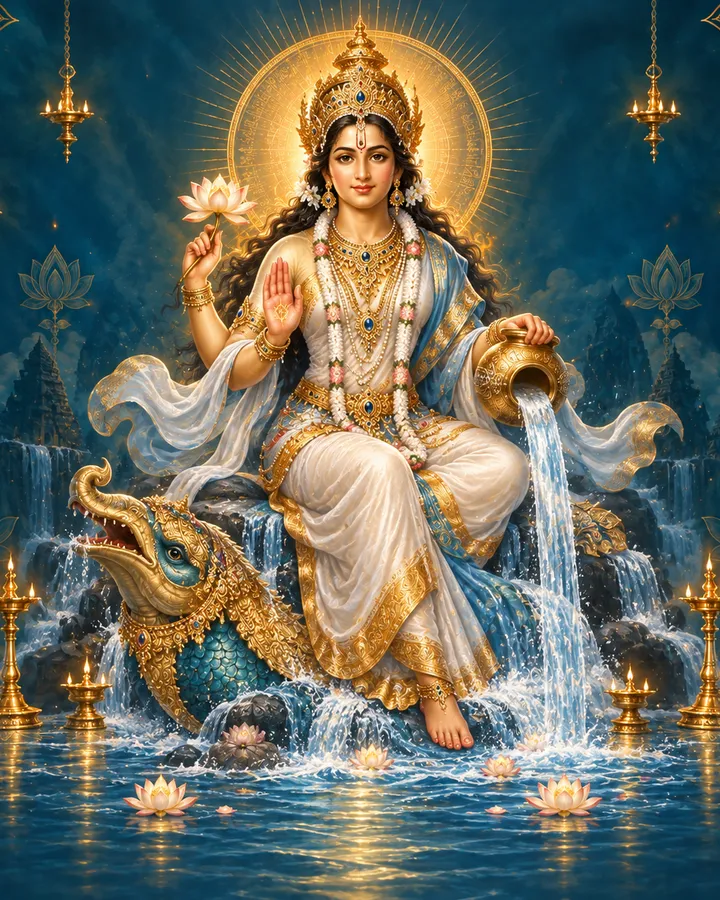
She is depicted as a fair, four-armed goddess riding a makara, a crocodile-headed, fish- or dolphin-tailed creature, carrying a water-lily and a kalasha, a ritual water pot. Unlike most other major goddesses, no fierce or wrathful form is attributed to her anywhere in the tradition.
Family
Ganga’s genealogy is genuinely inconsistent across Puranic sources, and this page presents the variation rather than resolving it. Some texts name her, alongside Parvati, a daughter of Himavan and Mena — though this is not universal across the tradition. The Devi Bhagavata Purana instead describes her as originally one of Vishnu’s three wives, alongside Lakshmi and Saraswati, cursed to become a river after a dispute among the goddesses. The Bhagavata Purana gives a different account again, describing her as arising from water that washed the feet of Vishnu in his Vamana avatar — the source of her epithet Vishnupadi.
Her clearest and best-attested relationship is not with a divine consort but a mortal one: in the Mahabharata, she marries King Shantanu and bears him eight sons, the Vasus, drowning seven of them at birth under a curse before relenting; the eighth, Devavrata, survives to become Bhishma, one of the epic’s central figures.
Descent to earth
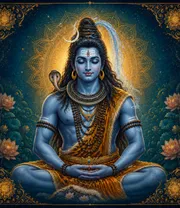
Ganga’s descent from heaven to earth, Gangavatarana, is one of Hindu mythology’s most widely told stories. King Bhagiratha performed severe austerities to bring her down to earth in order to liberate the souls of his 60,000 ancestors, the sons of King Sagara, who had been reduced to ashes by a sage’s curse and could only be freed by the touch of her sacred water. So powerful was the force of her descent that Shiva is said to have caught her in his matted hair to break her fall, releasing her onto the earth in a form the land could bear — the reason he carries the epithet Gangadhara, “bearer of the Ganges.”
Worship and festivals
Ganga Dussehra, on the tenth day of the waxing moon in the month of Jyeshtha, typically in May or June, marks her descent from heaven and is the occasion for large bathing festivals at ghats along the river. Ganga Jayanti, on the seventh day of Vaishakha’s waxing fortnight, commemorates a separate episode in which the sage Jahnu, angered at her flooding his sacrifice, drank her waters and later released her from his ear — the origin of her name Jahnavi, “daughter of Jahnu.” Her water and image are also invoked during Navaratri as a form of Adishakti, and cremation and ash-immersion practices tied to belief in moksha remain among the most visible living expressions of her worship today.
In scripture
- Rigveda (Nadistuti sukta, 10.75) — an early hymn naming her among the sacred rivers.
- Ramayana and Mahabharata — the Bhagiratha and Shantanu-Bhishma narratives respectively.
- Bhagavata Purana and Devi Bhagavata Purana — the two differing origin accounts described above.
Iconography at a glance
Major temples
Har Ki Pauri
Haridwar, Uttarakhand, India
The ghat traditionally held to mark where the Ganges leaves the mountains for the plains; site of the Brahmakund and the nightly Ganga Aarti.
Open in Maps ↗Gangotri Temple
Gangotri, Uttarakhand, India
Built by Gorkha commander Amar Singh Thapa in the early 18th century; marks the traditional source region of the Ganges in the Himalayas, at roughly 3,100 meters elevation.
Open in Maps ↗Worth knowing
- Ganga's descent to earth, known as Gangavatarana, is traditionally credited to the austerities of King Bhagiratha, undertaken to liberate the 60,000 sons of King Sagara.
- Shiva is said to have broken Ganga's fall from heaven by catching her in his matted hair before releasing her onto the earth — the reason he carries the epithet Gangadhara, "bearer of the Ganges."
- Multiple, differing Puranic accounts exist for her origin, and no single one is treated as canonical across all texts.
- In the Mahabharata, Ganga is the mother of Bhishma, one of the epic's central figures.
- Unlike most major goddesses, no fierce or destructive form is attributed to her in Hindu iconography — she is consistently depicted as wholly benevolent.