

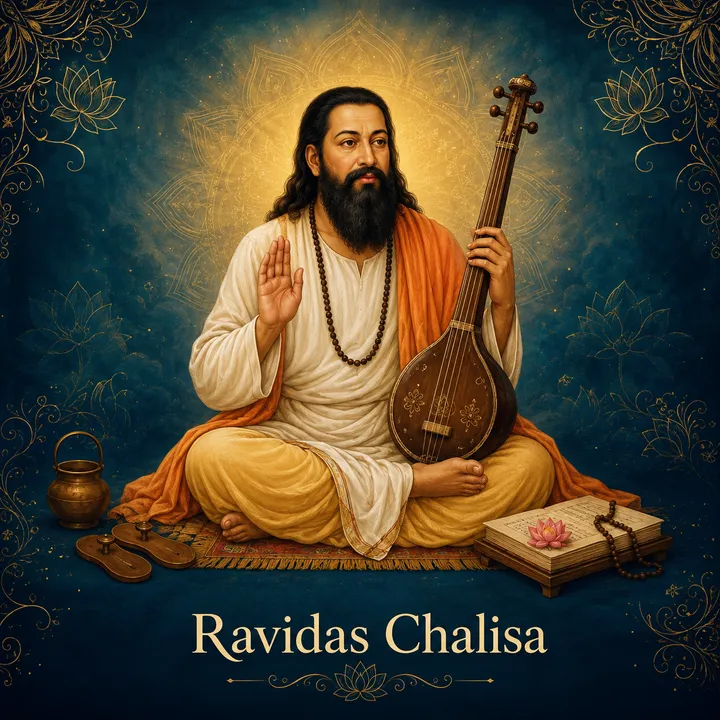
The text
Tap Recite along to follow verse by verse — use Next, or the arrow keys.
- Opening dohas
- Doha (opening) 1
बंदौं वीणा पाणि को, देहु आय मोहिं ज्ञान।पाय बुद्धि रविदास को, करौं चरित्र बखान॥
bandauṃ vīṇā pāṇi ko, dehu āya mohiṃ jñāna।pāya buddhi ravidāsa ko, karauṃ caritra bakhāna॥
I bow to her who holds the veena: come and give me knowledge. Having received understanding, I shall tell the story of Ravidas.
- Doha (opening) 2
मातु की महिमा अमित है, लिखि न सकत है दास।ताते आयों शरण में, पुरवहु जन की आस॥
mātu kī mahimā amita hai, likhi na sakata hai dāsa।tāte āyoṃ śaraṇa meṃ, puravahu jana kī āsa॥
The Mother's glory is measureless; this servant cannot write it down. So I have come for refuge — fulfil your devotee's hope.
- The 40 chaupais
- Chaupai 1
जै होवै रविदास तुम्हारी।कृपा करहु हरिजन हितकारी॥
jai hovai ravidāsa tumhārī।kṛpā karahu harijana hitakārī॥
Victory be yours, Ravidas; show your grace, benefactor of Hari's people.
- Chaupai 2
राहु भक्त तुम्हारे ताता।कर्मा नाम तुम्हारी माता॥
rāhu bhakta tumhāre tātā।karmā nāma tumhārī mātā॥
Your father was the devotee Rahu; your mother's name was Karma.
- Chaupai 3
काशी ढिंग माडुर स्थाना।वर्ण अछूत करत गुजराना॥
kāśī ḍhiṅga māḍura sthānā।varṇa achūta karata gujarānā॥
Near Kashi lay the place Madur; of untouchable caste, you made your living.
- Chaupai 4
द्वादश वर्ष उम्र जब आई।तुम्हरे मन हरि भक्ति समाई॥
dvādaśa varṣa umra jaba āī।tumhare mana hari bhakti samāī॥
When you reached the age of twelve, devotion to Hari filled your mind.
- Chaupai 5
रामानन्द के शिष्य कहाये।पाय ज्ञान निज नाम बढ़ाये॥
rāmānanda ke śiṣya kahāye।pāya jñāna nija nāma baḍhāye॥
You were called a disciple of Ramanand; receiving knowledge, you raised your own name.
- Chaupai 6
शास्त्र तर्क काशी में कीन्हों।ज्ञानिन को उपदेश है दीन्हों॥
śāstra tarka kāśī meṃ kīnhoṃ।jñānina ko upadeśa hai dīnhoṃ॥
You held debate on scripture in Kashi, and gave teaching to the learned.
- Chaupai 7
गंग मातु के भक्त अपारा।कौड़ी दीन्ह उनहिं उपहारा॥
gaṅga mātu ke bhakta apārā।kauḍī dīnha unahiṃ upahārā॥
There was a boundless devotee of Mother Ganga; to him you gave a cowrie as the offering.
- Chaupai 8
पंडित जन ताको लै जाई।गंग मातु को दीन्ह चढ़ाई॥
paṇḍita jana tāko lai jāī।gaṅga mātu ko dīnha caḍhāī॥
The pandit carried it away and offered it to Mother Ganga.
- Chaupai 9
हाथ पसारि लीन्ह चौगानी।भक्त की महिमा अमित बखानी॥
hātha pasāri līnha caugānī।bhakta kī mahimā amita bakhānī॥
She stretched out her hand and took the chaugānī; the devotee's glory was told beyond measure.
- Chaupai 10
चकित भये पंडित काशी के।देखि चरित भव भय नाशी के॥
cakita bhaye paṇḍita kāśī ke।dekhi carita bhava bhaya nāśī ke॥
The pandits of Kashi were astonished, seeing the deed of him who destroys the fear of this world.
- Chaupai 11
रत्न जटित कंगन तब दीन्हाँ।रविदास अधिकारी कीन्हाँ॥
ratna jaṭita kaṅgana taba dīnhā̃।ravidāsa adhikārī kīnhā̃॥
She gave a jewelled bracelet then, and made Ravidas its owner.
- Chaupai 12
पंडित दीजौ भक्त को मेरे।आदि जन्म के जो हैं चेरे॥
paṇḍita dījau bhakta ko mere।ādi janma ke jo haiṃ cere॥
"Pandit, give it to that devotee of mine, who has been my servant since his first birth."
- Chaupai 13
पहुँचे पंडित ढिग रविदासा।दै कंगन पुरइ अभिलाषा॥
pahũce paṇḍita ḍhiga ravidāsā।dai kaṅgana purai abhilāṣā॥
The pandit came to Ravidas and gave the bracelet, and the longing was fulfilled.
- Chaupai 14
तब रविदास कही यह बाता।दूसर कंगन लावहु ताता॥
taba ravidāsa kahī yaha bātā।dūsara kaṅgana lāvahu tātā॥
Then Ravidas said this: "Bring a second bracelet, father."
- Chaupai 15
पंडित जन तब कसम उठाई।दूसर दीन्ह न गंगा माई॥
paṇḍita jana taba kasama uṭhāī।dūsara dīnha na gaṅgā māī॥
The pandit then swore an oath: Mother Ganga had given no second one.
- Chaupai 16
तब रविदास ने वचन उचारे।पंडित जन सब भये सुखारे॥
taba ravidāsa ne vacana ucāre।paṇḍita jana saba bhaye sukhāre॥
Then Ravidas spoke his words, and all the pandits were set at ease.
- Chaupai 17
जो सर्वदा रहै मन चंगा।तौ घर बसति मातु है गंगा॥
jo sarvadā rahai mana caṅgā।tau ghara basati mātu hai gaṅgā॥
"If the mind stays always pure, then Mother Ganga dwells in the house."
- Chaupai 18
हाथ कठौती में तब डारा।दूसर कंगन एक निकारा॥
hātha kaṭhautī meṃ taba ḍārā।dūsara kaṅgana eka nikārā॥
He put his hand into the washing-tub then, and drew out a second bracelet.
- Chaupai 19
चित संकोचित पंडित कीन्हें।अपने अपने मारग लीन्हें॥
cita saṅkocita paṇḍita kīnheṃ।apane apane māraga līnheṃ॥
The pandits were made small in their own minds, and each took his own road.
- Chaupai 20
तब से प्रचलित एक प्रसंगा।मन चंगा तो कठौती में गंगा॥
taba se pracalita eka prasaṅgā।mana caṅgā to kaṭhautī meṃ gaṅgā॥
From that time a saying has run: if the mind is pure, the Ganges is in the washing-tub.
- Chaupai 21
एक बार फिरि परयो झमेला।मिलि पंडितजन कीन्हों खेला॥
eka bāra phiri parayo jhamelā।mili paṇḍitajana kīnhoṃ khelā॥
Once more a quarrel arose: the pandits joined together and made a contest of it.
- Chaupai 22
सालिग राम गंग उतरावै।सोई प्रबल भक्त कहलावै॥
sāliga rāma gaṅga utarāvai।soī prabala bhakta kahalāvai॥
"Whoever can float a Shaligram on the Ganga, he shall be called the stronger devotee."
- Chaupai 23
सब जन गये गंग के तीरा।मूरति तैरावन बिच नीरा॥
saba jana gaye gaṅga ke tīrā।mūrati tairāvana bica nīrā॥
Everyone went to the Ganga's bank to float an image out in the water.
- Chaupai 24
डूब गईं सबकी मझधारा।सबके मन भयो दुःख अपारा॥
ḍūba gaīṃ sabakī majhadhārā।sabake mana bhayo duḥkha apārā॥
All of theirs sank in the middle of the stream, and every heart filled with boundless sorrow.
- Chaupai 25
पत्थर मूर्ति रही उतराई।सुर नर मिलि जयकार मचाई॥
patthara mūrti rahī utarāī।sura nara mili jayakāra macāī॥
The stone image stayed afloat; gods and men together raised a shout of victory.
- Chaupai 26
रह्यो नाम रविदास तुम्हारा।मच्यो नगर महँ हाहाकारा॥
rahyo nāma ravidāsa tumhārā।macyo nagara mahã hāhākārā॥
Your name, Ravidas, endured; an uproar broke out through the city.
- Chaupai 27
चीरि देह तुम दुग्ध बहायो।जन्म जनेऊ आप दिखाओ॥
cīri deha tuma dugdha bahāyo।janma janeū āpa dikhāo॥
You cut open your body and let milk flow, and showed the sacred thread you were born with.
- Chaupai 28
देखि चकित भये सब नर नारी।विद्वानन सुधि बिसरी सारी॥
dekhi cakita bhaye saba nara nārī।vidvānana sudhi bisarī sārī॥
All the men and women were astonished to see it; the learned lost their wits entirely.
- Chaupai 29
ज्ञान तर्क कबिरा संग कीन्हों।चकित उनहुँ का तुम करि दीन्हों॥
jñāna tarka kabirā saṅga kīnhoṃ।cakita unahũ kā tuma kari dīnhoṃ॥
You held debate on knowledge with Kabir, and left even him astonished.
- Chaupai 30
गुरु गोरखहि दीन्ह उपदेशा।उन मान्यो तकि संत विशेषा॥
guru gorakhahi dīnha upadeśā।una mānyo taki santa viśeṣā॥
You gave teaching to Guru Gorakh; he accepted it, taking you for a saint beyond the rest.
- Chaupai 31
सदना पीर तर्क बहु कीन्हाँ।तुम ताको उपदेश है दीन्हाँ॥
sadanā pīra tarka bahu kīnhā̃।tuma tāko upadeśa hai dīnhā̃॥
Sadna Pir argued at length; you gave him your teaching.
- Chaupai 32
मन महँ हारयो सदन कसाई।जो दिल्ली में खबरि सुनाई॥
mana mahã hārayo sadana kasāī।jo dillī meṃ khabari sunāī॥
Sadna the butcher was defeated in his own mind, and he it was who told the news in Delhi.
- Chaupai 33
मुस्लिम धर्म की सुनि कुबड़ाई।लोधि सिकन्दर गयो गुस्साई॥
muslima dharma kī suni kubaḍāī।lodhi sikandara gayo gussāī॥
Hearing the Muslim faith spoken ill of, Sikandar Lodi flew into a rage.
- Chaupai 34
अपने गृह तब तुमहिं बुलावा।मुस्लिम होन हेतु समुझावा॥
apane gṛha taba tumahiṃ bulāvā।muslima hona hetu samujhāvā॥
He called you then to his own house, and urged you to become a Muslim.
- Chaupai 35
मानी नाहिं तुम उसकी बानी।बंदीगृह काटी है रानी॥
mānī nāhiṃ tuma usakī bānī।bandīgṛha kāṭī hai rānī॥
You did not accept his word, and prison was what you endured.
- Chaupai 36
कृष्ण दरश पाये रविदासा।सफल भई तुम्हरी सब आशा॥
kṛṣṇa daraśa pāye ravidāsā।saphala bhaī tumharī saba āśā॥
Ravidas, you received the sight of Krishna; all your hope was fulfilled.
- Chaupai 37
ताले टूटि खुल्यो है कारा।नाम सिकन्दर के तुम मारा॥
tāle ṭūṭi khulyo hai kārā।nāma sikandara ke tuma mārā॥
The locks broke and the prison stood open; you struck down Sikandar's name.
- Chaupai 38
काशी पुर तुम कहँ पहुँचाई।दै प्रभुता अरुमान बड़ाई॥
kāśī pura tuma kahã pahũcāī।dai prabhutā arumāna baḍāī॥
You were brought to the city of Kashi, given lordship, honour and greatness.
- Chaupai 39
मीरा योगावति गुरु कीन्हों।जिनको क्षत्रिय वंश प्रवीनो॥
mīrā yogāvati guru kīnhoṃ।jinako kṣatriya vaṃśa pravīno॥
Mira and Jogavati took you as their guru — they of accomplished Kshatriya lineage.
- Chaupai 40
तिनको दै उपदेश अपारा।कीन्हों भव से तुम निस्तारा॥
tinako dai upadeśa apārā।kīnhoṃ bhava se tuma nistārā॥
To them you gave teaching without limit, and carried them across out of worldly existence.
- Closing dohas
- Doha (closing) 1
ऐसे ही रविदास ने, कीन्हें चरित अपार।कोई कवि गावै कितै, तहूं न पावै पार॥
aise hī ravidāsa ne, kīnheṃ carita apāra।koī kavi gāvai kitai, tahūṃ na pāvai pāra॥
In this way Ravidas performed deeds beyond number. However many poets sing of them, even then they do not reach the end.
- Doha (closing) 2
नियम सहित हरिजन अगर, ध्यान धरै चालीसा।ताकी रक्षा करेंगे, जगतपति जगदीशा॥
niyama sahita harijana agara, dhyāna dharai cālīsā।tākī rakṣā kareṅge, jagatapati jagadīśā॥
If one of Hari's people holds this chalisa in mind, keeping its observances, the Lord of the world, Jagadisha, will protect him.
Overview
Sant Ravidas (also spelled Raidas or Ravidass) was a fifteenth-century poet-saint of North India’s Bhakti movement, revered across Hindu, Sikh, and Ravidassia devotional traditions alike. Born in the Varanasi (Kashi) region into a family of leather-workers — a community treated as “untouchable” under the traditional caste system, a status the Chalisa itself names directly — he became one of the Sant tradition’s most influential voices for devotion (bhakti) offered directly to a formless divine, independent of caste, ritual, or birth. Forty of his hymns are preserved in the Guru Granth Sahib, the central scripture of Sikhism, alongside compositions by other Bhakti-era poets such as Kabir. The Ravidas Chalisa is a later devotional composition in his honor — not a text he wrote himself — following the widespread North Indian “chalisa” form: an opening pair of dohas, a body of forty numbered chaupai couplets, and a closing pair of dohas.
Origin and source
Unlike the Hanuman Chalisa, confidently attributed to Tulsidas, the Ravidas Chalisa carries no internal signature naming its author. It circulates as an anonymous devotional composition recounting the saint’s life and the wonders traditionally associated with him, rather than a text with a documented individual composer.
The chaupais narrate a sequence of episodes drawn from Ravidas’s hagiography. They describe his birth near Kashi and his turn to devotion as a boy; popular tradition holds that he became a disciple of the Bhakti teacher Ramananda, though the historical ties between Ramananda and his various reputed disciples are debated among scholars rather than firmly settled. Several chaupais recount the story of a bejeweled bracelet offered to the Ganges through a Brahmin intermediary and returned instead to Ravidas — the episode traditionally credited with the proverb “mana caṅgā to kaṭhautī meṃ gaṅgā” (“if the mind is pure, the Ganges is present even in a washing-tub”), still widely quoted in Hindi as a saying about sincerity mattering more than ritual form. Other verses recount a test in which a sacred Shaligram stone was floated on the Ganges as proof of devotion, an episode in which Ravidas is said to have opened his own chest to reveal a sacred thread as a sign of his spiritual standing, and exchanges with fellow Bhakti figures including Kabir, the yogi Gorakhnath, and Sadhna the butcher-saint (Sadna Kasai), whose own hymn likewise appears in the Guru Granth Sahib. The Chalisa’s later verses recount a confrontation with the Delhi Sultan Sikandar Lodi over pressure to abandon his faith, describing Ravidas’s imprisonment and release, and close by naming Mirabai as a disciple he instructed — a claim long-repeated in devotional retellings, though, like several episodes in the Chalisa, treated by historians as hagiography rather than documented biography. Read together, the verses present Ravidas’s teaching that sincere devotion — not birth or ritual status — is what draws a person near the divine.
The English meanings printed with the verses were made for this page from the Devanagari above. Only two published versions carrying the full text were found — Bhakti Bharat and Drik Panchang — and neither glosses it. Compared verse by verse, the two agree with this page on all forty-four apart from spelling and three clauses, and on all three they share the same reading against this page, which is what one lineage looks like rather than two independent witnesses. Two of the three read as print slips: रल जटित for रत्न जटित, “jewel-studded,” in Chaupai 11, and हार्योो for हारयो in Chaupai 32. The third is Chaupai 37, where this page prints नाम सिकन्दर के तुम मारा and both read माम — against which Bhakti Bharat’s own transliteration of that line reads “Nama.” This page keeps नाम and renders the line as it stands.
Two words are left out of the English rather than guessed at: चौगानी in Chaupai 9, which both versions also print and neither explains (Bhakti Bharat’s own transliteration gives it as “Chaigani”), and रानी in Chaupai 35, where the English renders काटी — what was endured — and leaves the last word out. कुबड़ाई in Chaupai 33 is rendered, not omitted: it is read here as the faith being spoken ill of, which is a reading and is named as one.
How it is recited
The Ravidas Chalisa is recited by devotees at home and in satsang gatherings, and is especially associated with Ravidas Jayanti, the saint’s birth anniversary observed on Magh Purnima (the full-moon day of the Hindu month of Magh, typically falling in January or February). The occasion is marked with particular devotion at Sant Ravidas temples, including the shrine at Seer Govardhanpur near Varanasi traditionally associated with his birthplace, and by Ravidassia and Sikh communities for whom Ravidas holds special significance as one of the Bhagat contributors to the Guru Granth Sahib.
Frequently asked questions
How many verses does Ravidas Chalisa have?
Who is Ravidas Chalisa dedicated to?
When is Ravidas Chalisa typically recited?
What language is Ravidas Chalisa composed in?
What tradition is Ravidas Chalisa associated with?
Is an English translation of Ravidas Chalisa available?
Is there a Roman transliteration of Ravidas Chalisa?
Sourcing
Checked against independent sources before publishing — see our sourcing and editorial policy. Spotted an error? Report an issue .