The text
Tap Recite along to follow verse by verse — use Next, or the arrow keys.
- Stanza 1 (refrain)
ॐ जय श्री रामादे स्वामी, जय श्री रामादे।पिता तुम्हारे अजमल, मैया मेनादे॥
oṃ jaya śrī rāmāde svāmī, jaya śrī rāmāde।pitā tumhāre ajamala, maiyā menāde॥
Om, victory to Lord Shri Ramade, victory to Shri Ramade. Your father is Ajmal, your mother Menade.
- Stanza 2
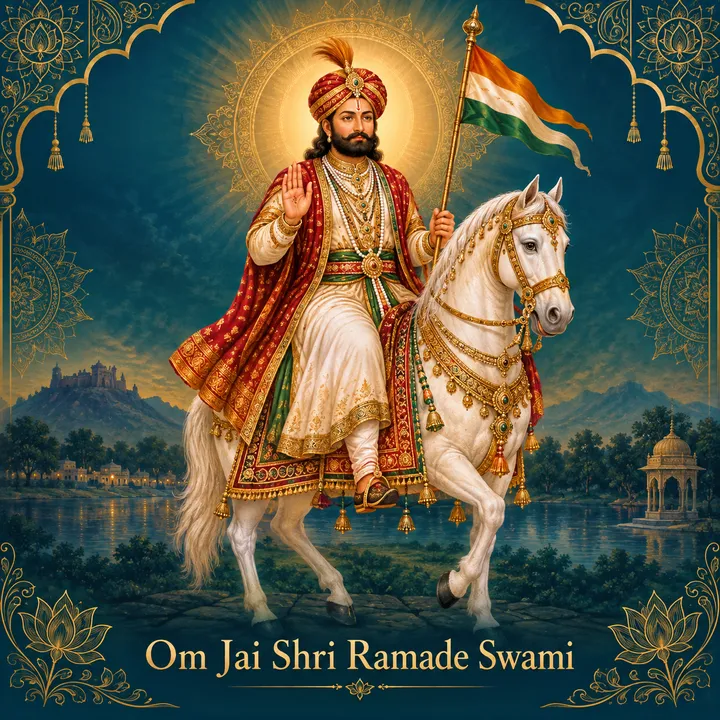
रूप मनोहर जिसका, घोड़े असवारी।कर में सोहे भाला, मुक्तामणि धारी॥ॐ जय श्री रामादे स्वामी, जय श्री रामादे॥
rūpa manohara jisakā, ghoḍe asavārī।kara meṃ sohe bhālā, muktāmaṇi dhārī॥oṃ jaya śrī rāmāde svāmī, jaya śrī rāmāde॥
His form is enchanting; he rides upon a horse. A lance graces his hand, and he wears pearl-jewels. Om, victory to Lord Shri Ramade, victory to Shri Ramade.
- Stanza 3
विष्णु रूप तुम स्वामी, कलियुग अवतारी।सुरनर मुनिजन ध्यावे, जावे बलिहारी॥ॐ जय श्री रामादे स्वामी, जय श्री रामादे॥
viṣṇu rūpa tuma svāmī, kaliyuga avatārī।suranara munijana dhyāve, jāve balihārī॥oṃ jaya śrī rāmāde svāmī, jaya śrī rāmāde॥
You are Vishnu in form, Lord — incarnate in the Kali Yuga. Gods, men and sages meditate on you and give themselves up to you. Om, victory to Lord Shri Ramade, victory to Shri Ramade.
- Stanza 4
दुःख दलजी का तुमने, पल भर में टारा।सरजीवन भाण को, तुमने कर डारा॥ॐ जय श्री रामादे स्वामी, जय श्री रामादे॥
duḥkha dalajī kā tumane, pala bhara meṃ ṭārā।sarajīvana bhāṇa ko, tumane kara ḍārā॥oṃ jaya śrī rāmāde svāmī, jaya śrī rāmāde॥
You turned away Dalji's sorrow in a moment. Bhāṇ you restored to life. Om, victory to Lord Shri Ramade, victory to Shri Ramade.
- Stanza 5
नाव सेठ की तारी, दानव को मारा।पल में कीना तुमने, सरवर को खारा॥ॐ जय श्री रामादे स्वामी, जय श्री रामादे॥
nāva seṭha kī tārī, dānava ko mārā।pala meṃ kīnā tumane, saravara ko khārā॥oṃ jaya śrī rāmāde svāmī, jaya śrī rāmāde॥
You carried the merchant's boat across and struck down the demon. In a moment you turned the lake's water salt. Om, victory to Lord Shri Ramade, victory to Shri Ramade.
Overview
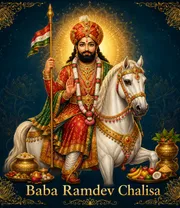
Om Jai Shri Ramade Swami is a short Hindi aarti — a five-stanza song of praise — offered to Baba Ramdev Pir, the medieval Rajasthani folk saint whose principal shrine stands at Ramdevra (Runicha), near Pokhran in Rajasthan’s Jaisalmer district. He is not the contemporary yoga teacher who also carries the name and title Baba Ramdev; the two are unrelated figures separated by centuries, sharing only a name and honorific. The aarti opens by naming Ramdev Pir’s parents, Ajmal and Menade, describes his handsome form mounted on horseback with a lance and pearls, and identifies him as an incarnation of Vishnu in the Kali Yuga. Its closing stanzas briefly recall a few of his parcha (miracles) — turning away the sorrow of a devotee called Dalji, restoring one named Bhāṇ to life, carrying a merchant’s boat across and turning a lake’s water salt — several of which are recounted at much greater length in the separate, forty-verse Baba Ramdev Chalisa already on this site. The aarti and the chalisa are distinct compositions within the same devotional tradition, not two versions of the same text.
Origin and source
No author is named within the aarti itself, and — as with the Baba Ramdev Chalisa — this page treats it as an anonymous composition from the oral and print tradition surrounding Ramdev Pir’s worship. Hindi devotional-lyrics collections carry the aarti with only minor wording differences between printings (for instance, some print टारा where others print तारा in the line about the devotee Dalji’s sorrow), consistent with a text that has circulated mainly by recitation and reprinting rather than from one fixed edition. The aarti’s brief references to a boat rescue and to a lake turned salt echo parcha recounted in full in the chalisa, suggesting the two compositions draw on the same body of oral narrative about Ramdev Pir even though their wording is unrelated line for line. Ramdev Pir’s own dating is treated variously across sources, and this page does not attempt to adjudicate between them.
The English meanings printed with the verses were made for this page from the Devanagari above; none of the six published versions consulted carries a gloss of its own. Compared verse by verse, one of the six prints all five stanzas exactly as this page prints them; three differ only in spelling and in dropping पल from “पल भर में”, two of those writing the refrain ओउम जय for ॐ जय. The remaining two differ in wording as well: one prints मीनलदे for the mother’s name मेनादे and तारा for टारा, and the other rewrites a line in each of Stanzas 3 and 4 and prints ताड़ी and किया in Stanza 5. One line needed a grammatical decision rather than a source. In Stanza 4 — सरजीवन भाण को तुमने कर डारा — the object marked by को is भाण, so सरजीवन is what is done to him, “restored to life,” and not his name, as an earlier version of this page stated. The Baba Ramdev Chalisa uses the word the same way in its own account of the twentieth parcha, where the merchant is made सरजीवण. Who Bhāṇ was is not identified in any of the sources consulted, and the English leaves the name as it stands. The chalisa does name a Dal ji, who receives a son in its nineteenth parcha; whether the aarti’s Dalji is the same devotee is not stated in either text.
How it is recited
Like the Baba Ramdev Chalisa, this aarti is sung by devotees at Ramdevra and at other shrines to Ramdev Pir across Rajasthan, as well as at home, with its opening refrain repeated by everyone present after each stanza. It is heard most widely during the Ramdevra Mela, the major annual fair held at his samadhi shrine in the Hindu month of Bhadrapada, when pilgrims travel to Ramdevra from across Rajasthan and neighboring states, alongside the region’s other aartis and chalisas to Ramdev Pir.
Frequently asked questions
How many verses does Om Jai Shri Ramade Swami have?
Who is Om Jai Shri Ramade Swami dedicated to?
When is Om Jai Shri Ramade Swami typically recited?
What language is Om Jai Shri Ramade Swami composed in?
What tradition is Om Jai Shri Ramade Swami associated with?
Is an English translation of Om Jai Shri Ramade Swami available?
Is there a Roman transliteration of Om Jai Shri Ramade Swami?
Sourcing
Checked against independent sources before publishing — see our sourcing and editorial policy. Spotted an error? Report an issue .