The text
Tap Recite along to follow verse by verse — use Next, or the arrow keys.
- Opening doha
- Doha (opening)
भुवन विराजी शारदा, महिमा अपरम्पार।भक्तों के कल्याण को, धरो मात अवतार॥
bhuvana virājī śāradā, mahimā aparampāra।bhaktoṃ ke kalyāṇa ko, dharo māta avatāra॥
Sharda, enthroned throughout creation, your glory has no equal; for the welfare of your devotees, Mother, you have taken this form.
- Refrain
- Refrain
मैया शारदा तोरे दरबार, आरती नित गाऊँ।नित गाऊँ मैया, नित गाऊँ।मैया शारदा तोरे दरबार, आरती नित गाऊँ॥
maiyā śāradā tore darabāra, āratī nita gāūṃ।nita gāūṃ maiyā, nita gāūṃ।maiyā śāradā tore darabāra, āratī nita gāūṃ॥
Mother Sharda, at your court I sing this aarti every day. Every day I sing, Mother, every day I sing. Mother Sharda, at your court I sing this aarti every day.
- The 6 stanzas
- Stanza 1
श्रद्धा को दीया, प्रीत की बाती, असुअन तेल चढ़ाऊँ।दरश तोरे पाऊँ।मैया शारदा तोरे दरबार, आरती नित गाऊँ॥
śraddhā ko dīyā, prīta kī bātī, asuana tela caṛhāūṃ।daraśa tore pāūṃ।maiyā śāradā tore darabāra, āratī nita gāūṃ॥
A lamp of faith, a wick of love, and the oil of my tears I offer up; may I receive your darshan. Mother Sharda, at your court I sing this aarti every day.
- Stanza 2
मन की माला, आँख के मोती, भाव के फूल चढ़ाऊँ।दरश तोरे पाऊँ।मैया शारदा तोरे दरबार, आरती नित गाऊँ॥
mana kī mālā, ā̃kha ke motī, bhāva ke phūla caṛhāūṃ।daraśa tore pāūṃ।maiyā śāradā tore darabāra, āratī nita gāūṃ॥
A garland of the mind, pearls from my eyes, and flowers of devotion I offer up; may I receive your darshan. Mother Sharda, at your court I sing this aarti every day.
- Stanza 3
बल को भोग, स्वांस दिन राती, कंधे से विनय सुनाऊँ।दरश तोरे पाऊँ।मैया शारदा तोरे दरबार, आरती नित गाऊँ॥
bala ko bhoga, svāṃsa dina rātī, kandhe se vinaya sunāūṃ।daraśa tore pāūṃ।maiyā śāradā tore darabāra, āratī nita gāūṃ॥
The strength of my breath, day and night, is the bhog I bring, and with bowed shoulders I voice this humble prayer; may I receive your darshan. Mother Sharda, at your court I sing this aarti every day.
- Stanza 4
तप को हार, कर्ण को टीका, ध्यान की ध्वजा चढ़ाऊँ।दरश तोरे पाऊँ।मैया शारदा तोरे दरबार, आरती नित गाऊँ॥
tapa ko hāra, karṇa ko ṭīkā, dhyāna kī dhvajā caṛhāūṃ।daraśa tore pāūṃ।maiyā śāradā tore darabāra, āratī nita gāūṃ॥
Austerity as a garland, devotion as an ornament for the ear, and the banner of meditation I offer up; may I receive your darshan. Mother Sharda, at your court I sing this aarti every day.
- Stanza 5
माँ के भजन, साधु सन्तन को, आरती रोज सुनाऊँ।दरश तोरे पाऊँ।मैया शारदा तोरे दरबार, आरती नित गाऊँ॥
mā̃ ke bhajana, sādhu santana ko, āratī roja sunāūṃ।daraśa tore pāūṃ।maiyā śāradā tore darabāra, āratī nita gāūṃ॥
The Mother's devotional songs I sing every day to the saints and holy ones as her aarti; may I receive your darshan. Mother Sharda, at your court I sing this aarti every day.
- Stanza 6
सुमर-सुमर, माँ के जस गावें, चरनन शीश नवाऊँ।दरश तोरे पाऊँ।मैया शारदा तोरे दरबार, आरती नित गाऊँ॥
sumara-sumara, mā̃ ke jasa gāve̐, caranana śīśa navāūṃ।daraśa tore pāūṃ।maiyā śāradā tore darabāra, āratī nita gāūṃ॥
Remembering you again and again, singing the Mother's glory, I bow my head at your feet; may I receive your darshan. Mother Sharda, at your court I sing this aarti every day.
- Refrain
- Refrain (closing)
मैया शारदा तोरे दरबार, आरती नित गाऊँ॥
maiyā śāradā tore darabāra, āratī nita gāūṃ॥
Mother Sharda, at your court I sing this aarti every day.
Overview
Maiya Sharda Tore Darbar is a short Hindi lamp-offering aarti addressed to Sharda Mata, built around a single refrain — “Maiya Sharda tore darbar, aarti nit gaun” (“Mother Sharda, at your court I sing this aarti every day”) — repeated after each of six brief stanzas. Every stanza follows the same pattern common to this style of devotional song: an item of physical worship named in one line is answered in the next by an inner, spiritual counterpart — a lamp of faith lit with a wick of love and the oil of tears, a garland strung from the mind with pearls from the eyes and flowers of devotion, austerity offered as a garland and devotion as an ear-ornament — and each stanza closes with the same plea, “daraś tore paun,” “may I receive your darshan.”
Origin and source
As with most aartis of this kind, Maiya Sharda Tore Darbar’s authorship is not established in the devotional literature that carries it, and it circulates as a traditional composition rather than one confidently attributed to a named poet.
The text is attested in independent devotional collections that differ in spelling and formatting rather than mirroring one another: a 2018 blog compilation of “Sarv Devi Devta Aarti” gives the text in full, spelling the plea for darshan “दरश तोरे पाऊँ” and writing out each repeated line by hand, while a separate lyrics collection on Drik Panchang — a long-running Hindu calendar and devotional-text site — gives the same content with a different repeat convention (“x2,” “x3” markers rather than spelled-out repetition) and the alternate spelling “दर्श तोरे पाऊँ.” That kind of divergence in spelling and formatting, while the underlying stanzas and their order match exactly, is the signature of two separately kept transcriptions of an orally transmitted song rather than one site copying the other.
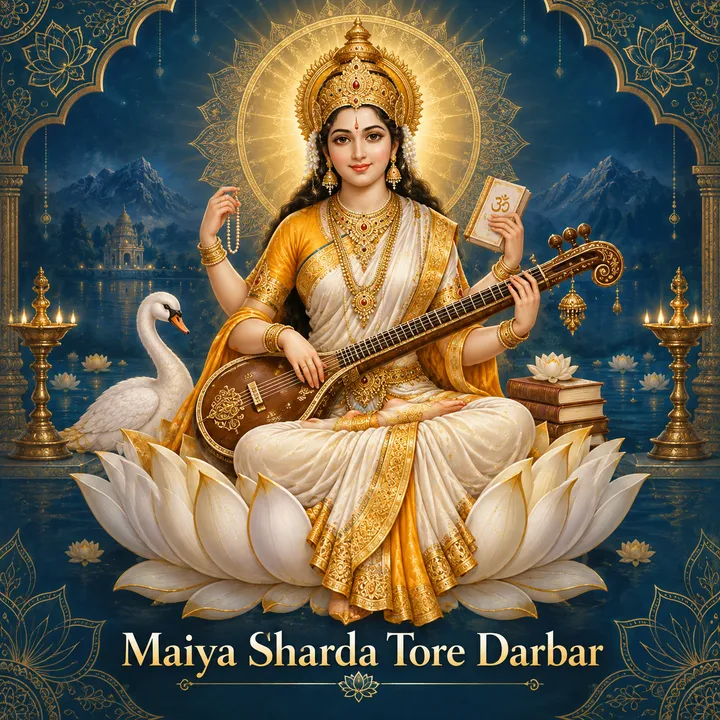
Sharda is widely regarded by devotees as a form of Saraswati, goddess of learning — the same identification noted on this site’s Sharda Mata Chalisa page. This aarti’s own verses, however, never mention Saraswati or describe Sharda’s iconography (the veena, the swan, the four arms) the way the chalisa does; they consist entirely of the offering-and-plea structure described above, so no textual identification with Saraswati is made here.
How it is recited
Maiya Sharda Tore Darbar is sung with a lit lamp or diya circled before an image of Sharda Mata, in the manner of any aarti, with the refrain taken up by everyone present after each stanza. Devotional publishers describe it as the most prominent aarti associated with Sharda Mata, sung on most occasions dedicated to her worship rather than being tied to one particular festival.
Frequently asked questions
How many verses does Maiya Sharda Tore Darbar have?
Who is Maiya Sharda Tore Darbar dedicated to?
When is Maiya Sharda Tore Darbar typically recited?
What language is Maiya Sharda Tore Darbar composed in?
What tradition is Maiya Sharda Tore Darbar associated with?
Is an English translation of Maiya Sharda Tore Darbar available?
Is there a Roman transliteration of Maiya Sharda Tore Darbar?
Sourcing
Checked against independent sources before publishing — see our sourcing and editorial policy. Spotted an error? Report an issue .