

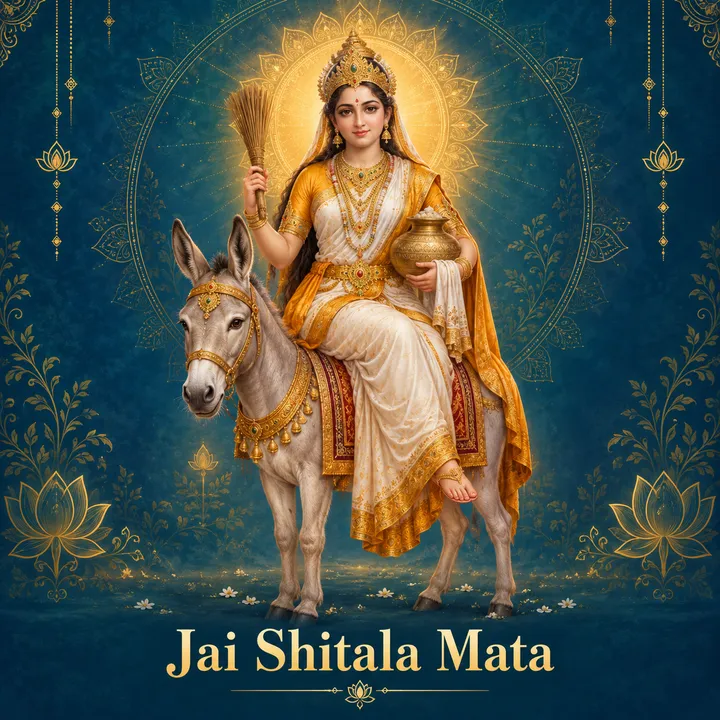
The text
Tap Recite along to follow verse by verse — use Next, or the arrow keys.
- Stanza 1 (refrain)
जय शीतला माता, मैया जय शीतला माता।आदि ज्योति महारानी सब फल की दाता॥ॐ जय शीतला माता॥
jaya śītalā mātā, maiyā jaya śītalā mātā।ādi jyoti mahārānī saba phala kī dātā॥oṃ jaya śītalā mātā॥
Victory to Shitala Mata, Mother, victory to Shitala Mata. Primordial light, great queen, giver of every fruit of one's deeds. Om, victory to Shitala Mata.
- Stanza 2
रतन सिंहासन शोभित, श्वेत छत्र भाता।ऋद्धि-सिद्धि चँवर डोलावें, जगमग छवि छाता॥ॐ जय शीतला माता॥
ratana siṃhāsana śobhita, śveta chatra bhātā।ṛddhi-siddhi caṃvara ḍolāveṃ, jagamaga chavi chātā॥oṃ jaya śītalā mātā॥
Radiant on a jeweled throne, a white canopy pleasing above you. Riddhi and Siddhi wave the fly-whisk beside you, your form glowing with light. Om, victory to Shitala Mata.
- Stanza 3
विष्णु सेवत ठाढ़े, सेवें शिव धाता।वेद पुराण वरणत पार नहीं पाता॥ॐ जय शीतला माता॥
viṣṇu sevata ṭhāḍhe, seveṃ śiva dhātā।veda purāṇa varaṇata pāra nahīṃ pātā॥oṃ jaya śītalā mātā॥
Vishnu stands in your service, and Shiva and Brahma (Dhata) serve you too. The Vedas and Puranas, describing you, cannot find your limit. Om, victory to Shitala Mata.
- Stanza 4
इन्द्र मृदङ्ग बजावत चन्द्र वीणा हाथा।सूरज ताल बजावै नारद मुनि गाता॥ॐ जय शीतला माता॥
indra mṛdaṅga bajāvata candra vīṇā hāthā।sūraja tāla bajāvai nārada muni gātā॥oṃ jaya śītalā mātā॥
Indra plays the mridangam, and the moon holds the veena in hand. The sun keeps the beat on cymbals, and the sage Narada sings your praise. Om, victory to Shitala Mata.
- Stanza 5
घण्टा शङ्ख शहनाई बाजै मन भाता।करै भक्त जन आरती लखि लखि हर्षाता॥ॐ जय शीतला माता॥
ghaṇṭā śaṅkha śahanāī bājai mana bhātā।karai bhakta jana āratī lakhi lakhi harṣātā॥oṃ jaya śītalā mātā॥
Bell, conch, and shehnai play, pleasing to the mind. Devotees perform your aarti, and their hearts rejoice again and again at the sight. Om, victory to Shitala Mata.
- Stanza 6
ब्रह्म रूप वरदानी तुही तीन काल ज्ञाता।भक्तन को सुख देती मातु पिता भ्राता॥ॐ जय शीतला माता॥
brahma rūpa varadānī tuhī tīna kāla jñātā।bhaktana ko sukha detī mātu pitā bhrātā॥oṃ jaya śītalā mātā॥
In the form of Brahman and giver of boons, you alone know the three times — past, present, and future. To your devotees you give happiness, as mother, father, and brother. Om, victory to Shitala Mata.
- Stanza 7
जो जन ध्यान लगावे प्रेम शक्ति पाता।सकल मनोरथ पावे भवनिधि तर जाता॥ॐ जय शीतला माता॥
jo jana dhyāna lagāve prema śakti pātā।sakala manoratha pāve bhavanidhi tara jātā॥oṃ jaya śītalā mātā॥
Whoever fixes their mind on you in meditation gains love and strength; all wishes are fulfilled, and one crosses the ocean of worldly existence. Om, victory to Shitala Mata.
- Stanza 8
रोगों से जो पीड़ित कोई शरण तेरी आता।कोढ़ी पावे निर्मल काया अन्ध नेत्र पाता॥ॐ जय शीतला माता॥
rogoṃ se jo pīḍita koī śaraṇa terī ātā।koḍhī pāve nirmala kāyā andha netra pātā॥oṃ jaya śītalā mātā॥
Whoever suffers from illness and comes to your refuge finds relief — even one afflicted with disfiguring disease gains a clear body, and the blind gain sight. Om, victory to Shitala Mata.
- Stanza 9
बांझ पुत्र को पावे दारिद्र कट जाता।ताको भजै जो नाहीं सिर धुनि पछताता॥ॐ जय शीतला माता॥
bāṃjha putra ko pāve dāridra kaṭa jātā।tāko bhajai jo nāhīṃ sira dhuni pachatātā॥oṃ jaya śītalā mātā॥
The childless woman is blessed with a child, and poverty is cut away. Whoever does not worship you comes to regret it, striking their head in sorrow. Om, victory to Shitala Mata.
- Stanza 10
शीतल करती जन की तू ही है जग त्राता।उत्पत्ति बाला बिनाशन तू सब की माता॥ॐ जय शीतला माता॥
śītala karatī jana kī tū hī hai jaga trātā।utpatti bālā bināśana tū saba kī mātā॥oṃ jaya śītalā mātā॥
You bring coolness and relief to your people; you alone are the savior of the world. In you, creation and destruction are one — you are the mother of all. Om, victory to Shitala Mata.
- Stanza 11 (closing)
दास नारायण कर जोरी माता।भक्ति आपनी दीजै और न कुछ माता॥ॐ जय शीतला माता, मैया जय शीतला माता॥
dāsa nārāyaṇa kara jorī mātā।bhakti āpanī dījai aura na kuchha mātā॥oṃ jaya śītalā mātā, maiyā jaya śītalā mātā॥
Your servant Narayan folds his hands, O Mother. Grant me only your devotion, and nothing else. Om, victory to Shitala Mata — Mother, victory to Shitala Mata.
Overview
Jai Shitala Mata is an eleven-stanza Hindi aarti to Shitala Mata, a folk goddess worshipped across North India for protection from disease — historically smallpox and other fevers, and by extension illness in general. Its verses follow the standard aarti pattern of praising the goddess’s cosmic court (Vishnu, Shiva, and Brahma attend her; Indra, the sun, and the moon make music before her) before turning to her specific, practical powers: she cures the diseased and the blind, ends childlessness, and lifts poverty from any household that honors her — while whoever refuses her worship is left to regret it.
Origin and source
Like most folk-goddess aartis, Jai Shitala Mata circulates without a single, settled literary source — it is preserved through devotional pamphlets, lyric websites, and recordings rather than one fixed print edition. Cross-checking a wide set of independent Hindi devotional sites alongside a professionally produced Saregama Bhakti studio recording (sung by Rajalakshmee Sanjay) turns up the same eleven-stanza composition throughout, with the first nine stanzas agreeing closely — the kind of small wording variation ordinary in orally transmitted Hindi (for instance, this page’s seventh stanza reads “प्रेम शक्ति पाता” where the Saregama recording has “प्रेम भक्ति लाता”).
The tenth stanza and the closing signature stanza, however, genuinely fork into two distinguishable recensions rather than one. This page follows the reading — “दास नारायण कर जोरी माता” (“Your servant Narayan folds his hands, O Mother”) — attested by Drik Panchang’s lyrics archive and independently corroborated by several other Hindi devotional sites whose own wording of these two stanzas differs from Drik Panchang’s and from each other in ways that rule out simple copying (one closes instead with “दास नारायण करते तेरी। जोरी करे माता,” another renders the tenth stanza’s second line as “उत्पत्ति, पालन, विनाशन” rather than “उत्पत्ति बाला बिनाशन”) — evidence of more than one independent transcription lineage converging on the same signature name. A second recension, closing instead with “दास विचित्र कर जोड़े” (“Your servant Vichitra folds his hands”), and phrasing the tenth stanza’s second line as “उत्पत्ति व्याधि विनाशत तू सब की घाता,” is preserved by the Saregama recording and by a smaller set of sites that reproduce its exact wording throughout, including its distinctive spellings elsewhere in the text — consistent with one lineage rather than several independent witnesses. That recording credits its lyrics to “Raju Rajasthani,” billed as having “recreated” the aarti for the release; that is a modern studio credit for adapting a traditional song, not a claim to have composed it, and this page draws no further conclusion from it about how the “Vichitra” reading arose. Neither recension is silently favored here as the “correct” one; the disagreement is a real feature of how this aarti has been transmitted, not an error to resolve.
Verse-count note: the source list for this rollout gives six stanzas for this aarti. Every independent source consulted while researching this page — both recensions described above — carries the full eleven-stanza composition transcribed here; no source with only six stanzas was found. The shorter count in the source list appears to undercount the actual aarti rather than reflect a shorter variant in circulation.
Shitala Mata herself is never identified in this text as a form of Durga or any other established Puranic goddess — as with other folk mother-goddesses such as Ahoi Mata and Santoshi Mata, she is praised in her own right, using the wider Shakta idiom of a goddess attended by Vishnu, Shiva, and Brahma, rather than through a stated identity claim.
How it is recited
Jai Shitala Mata is sung especially during Sheetala Ashtami, also known as Basoda, observed roughly a week after Holi in the Krishna Paksha of Chaitra. Households mark the day by cooking no fresh food — the meal is prepared the day before and eaten cold — and by visiting a Shitala Mata shrine to offer that cold food along with water, seeking her protection from disease for the coming year, particularly for children. The aarti is sung at this puja, with a lit lamp waved before her image as the stanzas and refrain are recited.
Frequently asked questions
How many verses does Jai Shitala Mata have?
Who is Jai Shitala Mata dedicated to?
When is Jai Shitala Mata typically recited?
What language is Jai Shitala Mata composed in?
What tradition is Jai Shitala Mata associated with?
Is an English translation of Jai Shitala Mata available?
Is there a Roman transliteration of Jai Shitala Mata?
Sourcing
Checked against independent sources before publishing — see our sourcing and editorial policy. Spotted an error? Report an issue .

