

The text
Tap Recite along to follow verse by verse — use Next, or the arrow keys.
- Stanza 1 (refrain)
जय अहोई माता, जय अहोई माता।तुमको निसदिन ध्यावत, हर विष्णु विधाता॥ॐ जय अहोई माता॥
jaya ahoī mātā, jaya ahoī mātā।tumako nisadina dhyāvata, hara viṣṇu vidhātā॥oṃ jaya ahoī mātā॥
Victory to Ahoi Mata, victory to Ahoi Mata. Hara (Shiva), Vishnu, and Brahma (Vidhata) meditate on you day and night. Om, victory to Ahoi Mata.
- Stanza 2
ब्रह्माणी, रुद्राणी, कमला, तू ही है जगमाता।सूर्य-चन्द्रमा ध्यावत, नारद ऋषि गाता॥ॐ जय अहोई माता॥
brahmāṇī, rudrāṇī, kamalā, tū hī hai jagamātā।sūrya-candramā dhyāvata, nārada ṛṣi gātā॥oṃ jaya ahoī mātā॥
Brahmani, Rudrani, Kamala (Lakshmi) — you alone are the mother of the world. The sun and moon meditate on you, and the sage Narada sings your praise. Om, victory to Ahoi Mata.
- Stanza 3
माता रूप निरंजन, सुख-सम्पत्ति दाता।जो कोई तुमको ध्यावत, नित मंगल पाता॥ॐ जय अहोई माता॥
mātā rūpa nirañjana, sukha-sampatti dātā।jo koī tumako dhyāvata, nita maṅgala pātā॥oṃ jaya ahoī mātā॥
Mother of pure, formless nature, giver of happiness and prosperity — whoever meditates on you obtains lasting well-being. Om, victory to Ahoi Mata.
- Stanza 4
तू ही पाताल बसंती, तू ही है शुभदाता।कर्म-प्रभाव प्रकाशक, जगनिधि से त्राता॥ॐ जय अहोई माता॥
tū hī pātāla basantī, tū hī hai śubhadātā।karma-prabhāva prakāśaka, jaganidhi se trātā॥oṃ jaya ahoī mātā॥
You dwell in the netherworld, and you alone are the giver of auspiciousness. You reveal the workings of karma, and save your devotees from the ocean of the world. Om, victory to Ahoi Mata.
- Stanza 5
जिस घर थारो वासा, वाहि में गुण आता।कर न सके सोई कर ले, मन नहीं घबराता॥ॐ जय अहोई माता॥
jisa ghara thāro vāsā, vāhi meṃ guṇa ātā।kara na sake soī kara le, mana nahīṃ ghabarātā॥oṃ jaya ahoī mātā॥
The house where you come to dwell fills with virtue; what one could not otherwise accomplish is achieved, and the mind does not fear. Om, victory to Ahoi Mata.
- Stanza 6
तुम बिन सुख न होवे, न कोई पुत्र पाता।खान-पान का वैभव, तुम बिन नहीं आता॥ॐ जय अहोई माता॥
tuma bina sukha na hove, na koī putra pātā।khāna-pāna kā vaibhava, tuma bina nahīṃ ātā॥oṃ jaya ahoī mātā॥
Without you there is no happiness, and no one is blessed with a child; without you, abundance of food and sustenance does not come. Om, victory to Ahoi Mata.
- Stanza 7
शुभ गुण सुंदर युक्ता, क्षीर निधि जाता।रतन चतुर्दश तोकू, कोई नहीं पाता॥ॐ जय अहोई माता॥
śubha guṇa sundara yuktā, kṣīra nidhi jātā।ratana caturdaśa tokū, koī nahīṃ pātā॥oṃ jaya ahoī mātā॥
Endowed with beautiful, auspicious qualities, you arose from the ocean of milk; without you, no one can obtain its fourteen treasures. Om, victory to Ahoi Mata.
- Stanza 8
श्री अहोई माँ की आरती, जो कोई गाता।उर उमंग अति उपजे, पाप उतर जाता॥ॐ जय अहोई माता, मैया जय अहोई माता॥
śrī ahoī māṃ kī āratī, jo koī gātā।ura umaṅga ati upaje, pāpa utara jātā॥oṃ jaya ahoī mātā, maiyā jaya ahoī mātā॥
Whoever sings this aarti of Shri Ahoi Ma, great joy wells up in the heart, and sin falls away. Om, victory to Ahoi Mata — Mother, victory to Ahoi Mata.
Overview
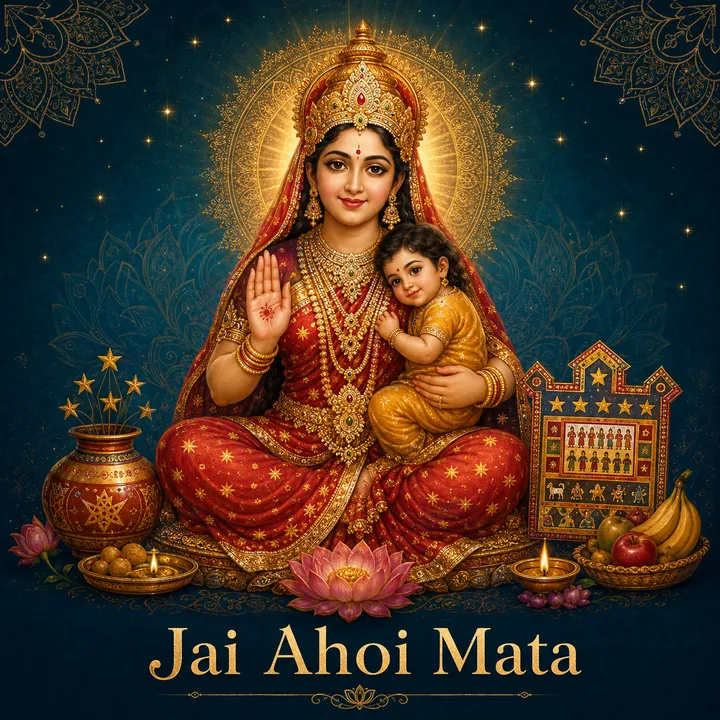
Jai Ahoi Mata is a Hindi aarti of eight stanzas addressed to Ahoi Mata, a folk mother-goddess whose worship centers on the protection, health, and long life of children. Unlike aartis built around a demon-slaying narrative, its verses stay close to that single concern: a household blessed by her presence gains virtue and finds a way through what once seemed impossible, children are born and kept safe, and daily sustenance and well-being flow from her grace. It is sung by mothers across North India as part of the Ahoi Ashtami vrat, a fast kept specifically on their children’s behalf.
Origin and source
Like many folk-goddess aartis sung across North Indian households, Jai Ahoi Mata circulates without a settled single author or textual source — it is preserved orally and in vrat-katha pamphlets rather than a fixed literary text. Its language places Ahoi Mata within the wider Shakta idiom shared by other Devi aartis: she is praised as one with Brahmani, Rudrani, and Kamala (Lakshmi), the mother of the world meditated on by the sun, the moon, and the sage Narada. This is devotional convention common to many Devi hymns rather than a claim specific to any one established goddess, and the aarti itself never names her as a form of Durga or any other established goddess — her identity here is simply Ahoi Mata, worshipped in her own right as the protector of children, alongside folk mother-goddesses such as Santoshi Mata and Shitala Mata who likewise hold independent traditions distinct from the Puranic Devi.
How it is recited
Jai Ahoi Mata is sung during the Ahoi Ashtami vrat, observed on the Ashtami of Kartik’s Krishna Paksha, about a week before Diwali. Mothers keep a fast from sunrise, in many households drawing an image of Ahoi Mata on a wall in sindoor or chandan alongside her children, and break the fast only after the stars appear in the evening sky, offering water (arghya) to the stars before eating. The aarti is sung at this evening puja, after the Ahoi Ashtami vrat katha (the story of the fast) is recounted, as mothers pray for their children’s health, safety, and long life.
Frequently asked questions
How many verses does Jai Ahoi Mata have?
Who is Jai Ahoi Mata dedicated to?
When is Jai Ahoi Mata typically recited?
What language is Jai Ahoi Mata composed in?
What tradition is Jai Ahoi Mata associated with?
Is an English translation of Jai Ahoi Mata available?
Is there a Roman transliteration of Jai Ahoi Mata?
Sourcing
Checked against independent sources before publishing — see our sourcing and editorial policy. Spotted an error? Report an issue .

