

Overview
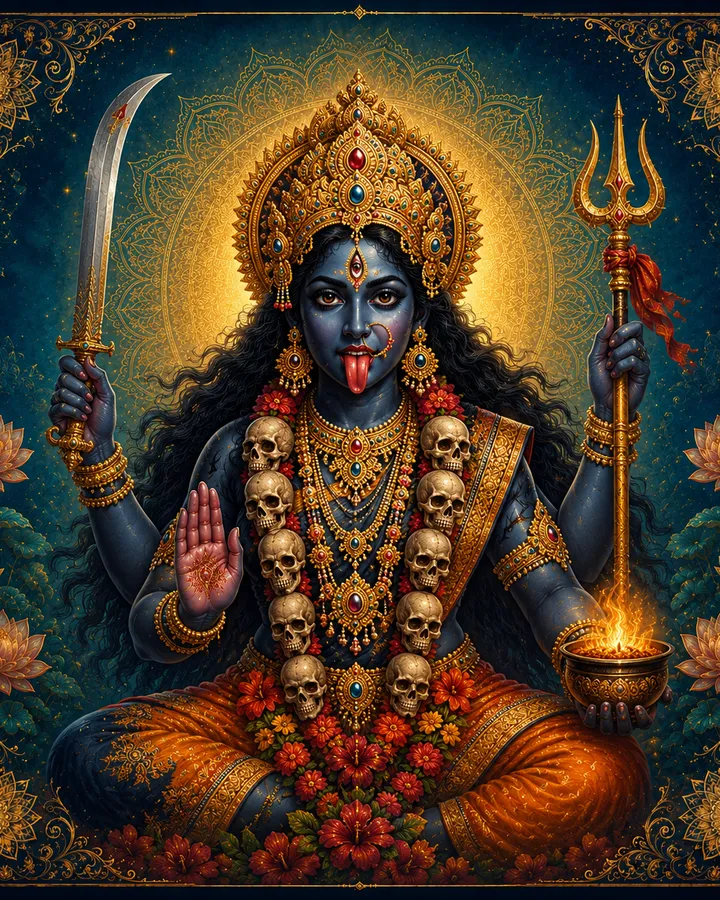
Kali Puja is Bengal’s night of Kartika Amavasya — the same new-moon night the rest of India keeps as Diwali — given to Kali rather than Lakshmi. The puja is at midnight, in pandals with a clay image of the goddess on the prone Shiva, tongue out, garlanded with heads, and at the great Kali temples of Kolkata: Kalighat and Dakshineswar. Homes light lamps as everywhere, and the fireworks are Bengal’s Diwali; the worship itself is Kali’s, with the red hibiscus, the offering at midnight, and the vigil. See the Kali page for the deity.
Story and scripture
Kali’s appearance is in the Devi Mahatmya’s third episode: she springs from Durga’s brow to kill Chanda and Munda and then Raktabija, whose every drop of blood raised another demon until she drank them. The Kalika Purana and the Tantric texts — the Mahanirvana Tantra above all — set the terms of her worship: at night, in nishita, with the offering, the red flowers and the bilva leaves. The Kartika Amavasya as her particular night is Bengal’s tradition; the Bengali tantric lineages hold that the new-moon night of Kartika, when the year turns to its dark half, is the night for Kali.
The public festival is eighteenth-century: Raja Krishnachandra Roy of Nadia is credited with promoting Kali Puja on the Durga Puja model, and by the nineteenth century the barowari (community) Kali Pujas of Kolkata were established. Ramakrishna’s worship of Kali at Dakshineswar in the same century made the temple the festival’s second centre after Kalighat; see the Ramakrishna page.
How the night is kept
Pandals and homes: the image installed on the day; the puja begins late in the evening and reaches the offering at midnight — the bali, once an animal and now in most pandals a pumpkin, sugarcane or a gourd; hibiscus garlands, red cloth, the dhuno incense; the goddess offered rice, fish and sweets in the Bengali way. The night is kept awake with kirtan and, in the older tradition, the Shyama sangeet — the songs to Kali of Ramprasad Sen.
At the temples: Kalighat and Dakshineswar hold the largest crowds of the year; the Tarapith temple in Birbhum keeps the night with its own tantric rite.
Jaap. Kali’s name — the Mahakali mantra linked below; the Kali Chalisa for those who read Hindi; the aarti Ambe Tu Hai Jagdambe Kali.
Regional forms
- West Bengal: Kali Puja everywhere, with Barasat’s pandals rivalling Kolkata’s in scale.
- Assam and Tripura: Kali Puja on the same night, at Kamakhya’s Kali shrine among others.
- Odisha: Kali Puja alongside Diwali’s lamps.
- Mithila (Bihar): Kali Puja at Kartika Amavasya, in the Maithil tradition.
- The rest of India: Diwali — Lakshmi Puja in pradosh; Bengalis elsewhere keep Kali Puja in their own pandals.
The date
The night on which Amavasya is current at nishita (the 48 minutes around local midnight) for Kolkata; this site computes the same for Delhi and Kolkata and notes any difference. Lakshmi Puja’s pradosh rule and Kali Puja’s midnight rule usually agree on the date but need not.
Dates 2026 and 2027
Dates are for New Delhi (IST), computed from the tithi rule for 1 Sept 2026 to 31 Dec 2027. Rows marked computed have not yet been checked against a published panchang — confirm with a local calendar before planning around them. Dates already past are kept for reference.
| Date | Observance | Tithi at sunrise | Tithi (IST) | Notes |
|---|---|---|---|---|
| Kali Puja | Krishna Chaturdashi, Kartika | 8 Nov 11:28 → 9 Nov 12:32 | computed | |
| Kali Puja | Krishna Chaturdashi, Kartika | 28 Oct 20:49 → 29 Oct 19:07 | computed |
Mantra, aarti and chalisa for Kali Puja
Frequently asked questions
When is Kali Puja in 2026?
When is Kali Puja in 2027?
Is Kali Puja the same as Diwali?
Why midnight?
When did Kali Puja become a public festival?
Which mantra is chanted?
Sourcing
Checked against independent sources before publishing — see our sourcing and editorial policy. Spotted an error? Report an issue .

