

Overview
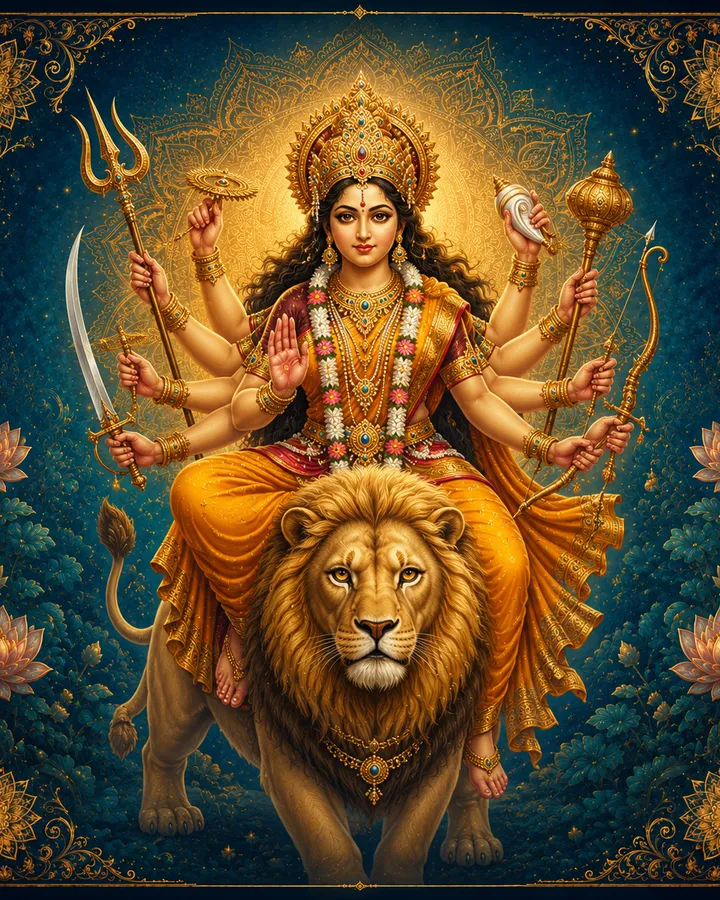
Durga Puja is Bengal’s festival — kept also in Odisha, Assam, Tripura, Bihar and wherever Bengalis live — and its form is distinct enough from the rest of Navratri to need its own page. The Goddess arrives with her four children (Lakshmi, Saraswati, Kartikeya and Ganesh) in a clay image made new each year, is worshipped in a temporary pavilion (pandal) for four days — Saptami, Ashtami, Navami — and leaves on Dashami, when the image is carried to the river. The whole city is the festival’s stage; a Kolkata pandal can be a work of architecture in bamboo and cloth, and the crowds go from one to the next all night.
Story and scripture
The text is the Devi Mahatmya of the Markandeya Purana, recited in the Chandi Path through the puja days; the story is Durga’s killing of Mahishasura. The autumn timing is explained by Akal Bodhan: the Kalika Purana and the Bengali Ramayana tradition (Krittibas) have Rama waking the Goddess out of season, in autumn rather than the spring that was her time, to seek her blessing before fighting Ravana. The Bodhon rite on Shashthi re-enacts that awakening, in a bilva tree.
The image itself follows a fixed iconography — Durga on the lion, the spear in Mahishasura, the four children flanking her — that the Kumortuli potters of Kolkata reproduce every year, and that Bengal reads as a daughter’s homecoming: Uma returning to her parents’ house for four days from Kailash.
The days
- Mahalaya (Ashwin Amavasya): the end of Pitru Paksha, the dawn broadcast of Mahishasura Mardini, and the chokkhu daan — the painting of the image’s eyes.
- Maha Shashthi: Bodhon in the evening — the Goddess invoked in the bilva branch; the face of the image unveiled.
- Maha Saptami: the Nabapatrika (nine plants bound as a figure, dressed as a bride and set beside Ganesh) bathed at dawn in the river and installed; the puja proper begins.
- Maha Ashtami: the anjali — flowers offered by the whole gathering after the priest’s mantras — is the day’s central act; Kumari Puja in some houses and at Belur Math; Sandhi Puja at the junction with Navami.
- Maha Navami: the main bhog offering, the fire offering (homa), and the last full day of worship.
- Vijaya Dashami: the morning Sindoor Khela, married women smearing vermilion on the image and each other; the immersion; then Bijoya — visiting elders, touching their feet, sweets.
Jaap during the puja days is a Durga mantra, or the Durga Chalisa for those who read Hindi; the Chandi Path is the priest’s and the family’s recitation.
Regional forms
- Kolkata and the rest of Bengal: the community (barowari / sarbojanin) pujas with their pandals, and the older household (bonedi bari) pujas in family courtyards.
- Odisha: Durga Puja with the same days; in Cuttack the images are ornamented with silver filigree (chandi medha).
- Assam: the same festival; Kamakhya and the Sakta shrines of Guwahati draw the largest crowds.
- Bihar, Jharkhand, Varanasi: pandal pujas on the Bengali model, alongside the north’s Navratri and Ramlila.
- Bengali communities abroad: the puja is kept over the nearest weekend when the tithis fall on working days; the tithi dates remain the ritual ones.
The dates
Each day is the day its tithi is current at sunrise for Kolkata; this site computes the same rule for Delhi and Kolkata and notes any day on which the civil date differs. Bengali panjikas may differ from a Drik-style calculation by a day when a tithi ends close to sunrise — the review note on each row says so. Sandhi Puja’s exact hour is not given here; a local panjika is the source for it.
Dates 2026 and 2027
Dates are for New Delhi (IST), computed from the tithi rule for 1 Sept 2026 to 31 Dec 2027. Rows marked computed have not yet been checked against a published panchang — confirm with a local calendar before planning around them. Dates already past are kept for reference.
| Date | Observance | Tithi at sunrise | Tithi (IST) | Notes |
|---|---|---|---|---|
| Maha Shashthi (Bodhon) | Shukla Shashthi, Ashwin | 16 Oct 03:26 → 17 Oct 05:55 | computed | |
| Maha Saptami | Shukla Saptami, Ashwin | 17 Oct 05:55 → 18 Oct 08:29 | Tithi spans 17 Oct 2026 and 18 Oct 2026 computed | |
| Maha Ashtami | Shukla Ashtami, Ashwin | 18 Oct 08:29 → 19 Oct 10:52 | computed | |
| Maha Navami | Shukla Navami, Ashwin | 19 Oct 10:52 → 20 Oct 12:51 | computed | |
| Vijaya Dashami | Shukla Dashami, Ashwin | 20 Oct 12:51 → 21 Oct 14:12 | computed | |
| Maha Shashthi (Bodhon) | Shukla Shashthi, Ashwin | 5 Oct 01:37 → 6 Oct 02:33 | computed | |
| Maha Saptami | Shukla Saptami, Ashwin | 6 Oct 02:33 → 7 Oct 04:14 | computed | |
| Maha Ashtami | Shukla Ashtami, Ashwin | 7 Oct 04:14 → 8 Oct 06:28 | Tithi spans 7 Oct 2027 and 8 Oct 2027 computed | |
| Maha Navami | Shukla Navami, Ashwin | 8 Oct 06:28 → 9 Oct 09:03 | computed | |
| Vijaya Dashami | Shukla Dashami, Ashwin | 9 Oct 09:03 → 10 Oct 11:41 | computed |
Mantra, aarti and chalisa for Durga Puja
Frequently asked questions
When is Durga Puja in 2026?
When is Durga Puja in 2027?
When does Durga Puja actually start?
What is Sandhi Puja?
Why do Bengali and North Indian dates sometimes differ?
Is the immersion always on Dashami?
Sourcing
Checked against independent sources before publishing — see our sourcing and editorial policy. Spotted an error? Report an issue .

