Overview
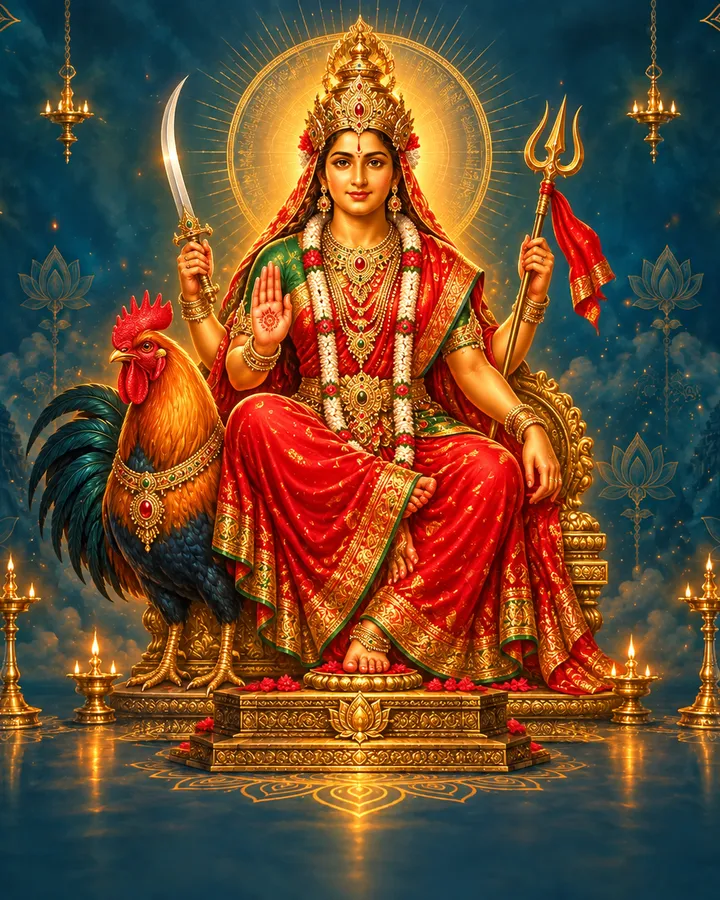
Bahuchara Mata (बहुचरा माता, Bahucharā Mātā) is a goddess worshipped principally in Gujarat, most consistently shown riding a rooster, her defining iconographic marker across every region and period. She is traditionally regarded as the patron goddess of the hijra and kinnar community, a devotional role documented as centuries old and closely tied to her central legend, told below.
Mythology
Her core story exists in more than one telling, and this page presents both rather than favoring one as canonical. In the most widely told version, Bahuchara was traveling with her sisters when they were attacked by a bandit near the Chunval region of Gujarat. Rather than submit, she and her sisters are said to have performed trāgā — a historically documented Charan practice of ritual self-sacrifice used as protest — cutting off their own breasts, and cursed the bandit with impotence, a curse he could lift only by dressing and living as a woman in her worship. A second, less central telling instead describes a prince named Jetho, afflicted with impotence, who prayed to her and was told to worship her while living as a woman or be reborn impotent for seven lifetimes. Both stories circulate within the tradition; this page does not treat either as more original than the other.
Iconography
Bahuchara’s rooster vehicle is her most stable attribute across regional depictions. She is often shown carrying a sword, evoking the self-sacrifice at the center of her legend, and sometimes a trishula, with one hand frequently raised in a blessing gesture. Live roosters are kept as sacred by devotees at and around her main temple.
Worship and the hijra and kinnar community
Bahuchara’s traditional role as patron goddess of the hijra and kinnar community is a genuinely old part of her worship, not a recent reframing. Hijra devotees — locally called Paviya in Gujarati — hold a customary ceremonial role in rituals and processions at her main temple, distinct from its priestly office, which belongs to a specific Brahmin lineage. This devotional relationship sits alongside her older role as a fertility goddess more broadly, to whom vows are also made for protection and the fulfillment of general wishes.
Temple and festivals
The Bahuchar Mata Temple at Becharaji, in Mehsana district, Gujarat, is her principal site of worship. Tradition traces an original shrine there to 1152 CE, associated with King Sankhal Raj; the temple seen today was substantially built and expanded in 1783 under Maratha Gaekwad patronage, and the site is organized in three tiers — the original Adyasthan, a middle Madhyasthan, and the main sanctum. Some local Gujarati tradition counts the site among the state’s Shakti Peethas, alongside Ambaji and Pavagadh, though it does not appear on every standard pan-Indian enumeration of the Shakti Peethas, which itself varies in count and membership across different source texts — this page notes the local claim without asserting it as a universally agreed classification. Bahuchara Navami is her principal dedicated festival, alongside broad participation in Navaratri.
Iconography at a glance
Major temple
Bahuchar Mata Temple
Becharaji, Mehsana district, Gujarat, India
Tradition traces an original shrine at this site to 1152 CE, associated with King Sankhal Raj; the present main temple complex was substantially built and expanded in 1783 under Maratha Gaekwad patronage. The site is organized in three tiers — the original Adyasthan, a middle Madhyasthan, and the main sanctum — and is administered today by the Gujarat Pavitra Yatradham Vikas Board.
Open in Maps ↗Worth knowing
- Bahuchara's vehicle, a rooster, is her most consistent iconographic marker across every depiction and region.
- Her worship is regionally counted among Gujarat's Shakti Peethas by some local tradition, alongside Ambaji and Pavagadh, though she does not appear on every standard pan-Indian list of the Shakti Peethas, which itself varies in count and membership by source text.
- She is traditionally regarded as the patron goddess of the hijra and kinnar community in parts of India, a devotional association documented as centuries old rather than a recent development; hijra devotees hold a customary ceremonial role in worship and procession at her main temple, distinct from the priestly office, which belongs to a specific Brahmin lineage.
- Her core legend exists in more than one telling — this page presents both rather than treating either as the single canonical version.
- She is popularly identified as a form of Durga, and in some regional traditions linked to Hinglaj Mata.