

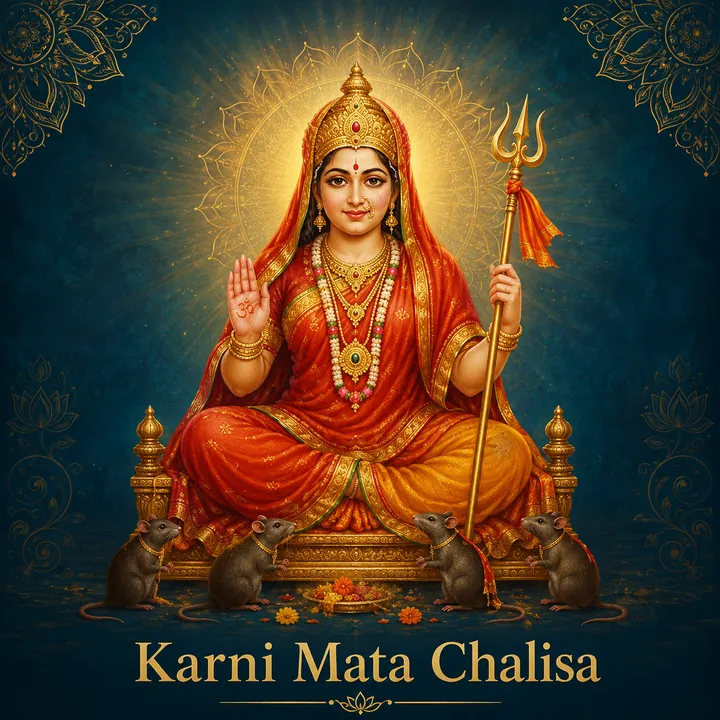
The text
Tap Recite along to follow verse by verse — use Next, or the arrow keys.
- Opening dohas
- Doha (opening) 1
जय गणेश जय गज बदन, करण सुमंगल मूल।करहू कृपा निज दास पर, रहहू सदा अनूकूल॥
jaya gaṇeśa jaya gaja badana, karaṇa sumaṃgala mūla।karahū kṛpā nija dāsa para, rahahū sadā anūkūla॥
Victory to Ganesh, victory to the elephant-faced one, the root of all good and auspicious beginnings — show your grace upon your own servant, and remain ever favorable to me.
- Doha (opening) 2
जय जननी जगदीश्वरी, कह कर बारम्बार।जगदम्बा करणी सुयश, वरणउ मति अनुसार॥
jaya jananī jagadīśvarī, kaha kara bārambāra।jagadambā karaṇī suyaśa, varaṇau mati anusāra॥
Saying again and again, "Victory to the Mother, sovereign of the universe," I shall describe the fair glory of Jagadamba Karni, according to my understanding.
- The 40 chaupais
- Chaupai 1
सूमिरौ जय जगदम्ब भवानी।महिमा अकथन जाय बखानी॥
sūmirau jaya jagadamba bhavānī।mahimā akathana jāya bakhānī॥
I remember and hail Jagadamba Bhavani — her glory is beyond telling, cannot be described.
- Chaupai 2
नमो नमो मेहाई करणी।नमो नमो अम्बे दुःख हरणी॥
namo namo mehāī karaṇī।namo namo ambe duḥkha haraṇī॥
Salutations, salutations to Karni, daughter of Mehaji; salutations, salutations to Amba, remover of sorrow.
- Chaupai 3
आदि शक्ति जगदम्बे माता।दुःख को हरणि सुख कि दाता॥
ādi śakti jagadambe mātā।duḥkha ko haraṇi sukha ki dātā॥
O primordial Shakti, Mother Jagadamba — remover of sorrow, giver of happiness.
- Chaupai 4
निरंकार है ज्योति तुम्हारी।तिहूं लोक फैलि उजियारो॥
niraṃkāra hai jyoti tumhārī।tihūṃ loka phaili ujiyāro॥
Formless is your light; it spreads its radiance through all three worlds.
- Chaupai 5
जो जेहि रूप से ध्यान लगावे।मन वांछित सोई फल पावे॥
jo jehi rūpa se dhyāna lagāve।mana vāṃchita soī phala pāve॥
Whoever fixes their meditation on you in whatever form, obtains the fruit their heart desires.
- Chaupai 6
धौलागढ़ में आप विराजो।सिंह सवारी सन्मुख साजो॥
dhaulāgaḍha meṃ āpa virājo।siṃha savārī sanmukha sājo॥
You reside at Dholagarh; mounted on your lion, you are arrayed before us.
- Chaupai 7
भैरो वीर रहे अगवानी।मारे असुर सकल अभिमानी॥
bhairo vīra rahe agavānī।māre asura sakala abhimānī॥
Bhairo Vir stands as your escort; you strike down all the arrogant demons.
- Chaupai 8
ग्राम सुआप नाम सुखकारी।चारण वंश करणी अवतारी॥
grāma suāpa nāma sukhakārī।cāraṇa vaṃśa karaṇī avatārī॥
In the village called Suap, bringer of happiness, you took incarnation as Karni within the Charan lineage.
- Chaupai 9
मुख मण्डल की सुन्दरताई।जाकी महिमा कही न जाई॥
mukha maṇḍala kī sundaratāī।jākī mahimā kahī na jāī॥
The beauty of your face — its glory cannot be told.
- Chaupai 10
जब भक्तों ने सुमिरण कीन्हा।ताही समय अभय करि दीन्हा॥
jaba bhaktoṃ ne sumiraṇa kīnhā।tāhī samaya abhaya kari dīnhā॥
When devotees remembered you, at that very moment you granted them fearlessness.
- Chaupai 11
साहूकार की करी सहाई।डूबत जल में नाव बचाई॥
sāhūkāra kī karī sahāī।ḍūbata jala meṃ nāva bacāī॥
You came to a merchant's aid, saving his boat as it sank in the water.
- Chaupai 12
जब कान्हे न कुमति बिचारी।केहरि रूप धरयो महतारी॥
jaba kānhe na kumati bicārī।kehari rūpa dharayo mahatārī॥
When Kanhe harbored an evil intent, the Mother took the form of a lioness.
- Chaupai 13
मारयो ताहि एक छन मांई।जाकी कथा जगत में छाई॥
mārayo tāhi eka chana māṃī।jākī kathā jagata meṃ chāī॥
She slew him in a single instant — a story that has spread across the whole world.
- Chaupai 14
नेड़ी जी शुभ धाम तुम्हारो।दर्शन करि मन होय सुखारो॥
neḍī jī śubha dhāma tumhāro।darśana kari mana hoya sukhāro॥
Nedi Ji is your auspicious abode; taking your darshan there brings joy to the heart.
- Chaupai 15
कर सौहै त्रिशूल विशाल।गल राजे पुष्प की माला॥
kara sauhai triśūla viśāla।gala rāje puṣpa kī mālā॥
A great trident graces your hand; a garland of flowers adorns your neck.
- Chaupai 16
शेखोजी पर किरपा कीन्ही।क्षुधा मिटाय अभय कर दीन्हा॥
śekhojī para kirapā kīnhī।kṣudhā miṭāya abhaya kara dīnhā॥
You showed grace upon Shekhoji, satisfying his hunger and granting him fearlessness.
- Chaupai 17
निर्बल होई जब सुमिरन कीन्हा।कारज सबि सुलभ कर दीन्हा॥
nirbala hoī jaba sumirana kīnhā।kāraja sabi sulabha kara dīnhā॥
When the weak and helpless remembered you, you made all their tasks easy.
- Chaupai 18
देशनोक पावन थल भारी।सुन्दर मंदिर की छवि न्यारी॥
deśanoka pāvana thala bhārī।sundara maṃdira kī chavi nyārī॥
Deshnoke is a great and sacred place; the image of its beautiful temple is unlike any other.
- Chaupai 19
मढ़ में ज्योति जले दिन राती।निखरत ही त्रय ताप नशाती॥
maḍha meṃ jyoti jale dina rātī।nikharata hī traya tāpa naśātī॥
In the shrine a flame burns day and night; its radiance alone destroys the three kinds of affliction.
- Chaupai 20
कीन्ही यहाँ तपस्या आकर।नाम उजागर सब सुख सागर॥
kīnhī yahā̃ tapasyā ākara।nāma ujāgara saba sukha sāgara॥
Coming here, you performed austerities; your name became renowned, an ocean of all happiness.
- Chaupai 21
जय करणी दुःख हरणी मइया।भव सागर से पार करइया॥
jaya karaṇī duḥkha haraṇī maiyā।bhava sāgara se pāra karaiyā॥
Victory to Karni, remover of sorrow, O Mother — you who carry us across the ocean of worldly existence.
- Chaupai 22
बार बार ध्याऊं जगदम्बा।कीजे दया करो न विलम्बा॥
bāra bāra dhyāūṃ jagadambā।kīje dayā karo na vilambā॥
Again and again I meditate on you, Jagadamba — show your grace, and do not delay.
- Chaupai 23
धर्मराज नै जब हठ कीन्हा।निज सुत को जीवित करि लीन्हा॥
dharmarāja nai jaba haṭha kīnhā।nija suta ko jīvita kari līnhā॥
When you stood firm before Dharmaraj, you brought your own son back to life.
- Chaupai 24
ताहि समय मर्याद बनाई।तुम पह मम वंशज नहि आई॥
tāhi samaya maryāda banāī।tuma paha mama vaṃśaja nahi āī॥
At that time this rule was set: "My descendants shall never come to you."
- Chaupai 25
मूषक बन मंदिर में रहि है।मूषक ते पुनि मानुष तन धरि है॥
mūṣaka bana maṃdira meṃ rahi hai।mūṣaka te puni mānuṣa tana dhari hai॥
They dwell in the temple in the form of mice; from that mouse-form they take on human form again.
- Chaupai 26
दिपोजी को दर्शन दीन्हा।निज लिला से अवगत कीन्हा॥
dipojī ko darśana dīnhā।nija lilā se avagata kīnhā॥
You granted darshan to Dipoji, making him aware of your divine play.
- Chaupai 27
बने भक्त पर कृपा कीन्ही।दो नैनन की ज्योति दीन्ही॥
bane bhakta para kṛpā kīnhī।do nainana kī jyoti dīnhī॥
You showed grace upon a devotee, restoring the light to both his eyes.
- Chaupai 28
चरित अमित अति कीन्ह अपारा।जाको यश छायो संसारा॥
carita amita ati kīnha apārā।jāko yaśa chāyo saṃsārā॥
You have performed countless, boundless deeds, whose fame has spread across the world.
- Chaupai 29
भक्त जनन को मात तारती।मगन भक्त जन करत आरती॥
bhakta janana ko māta tāratī।magana bhakta jana karata āratī॥
Mother, you carry your devotees across; joyful devotees perform your aarti.
- Chaupai 30
भीड़ पड़ी भक्तों पर जब ही।भई सहाय भवानी तब ही॥
bhīḍa paḍī bhaktoṃ para jaba hī।bhaī sahāya bhavānī taba hī॥
Whenever trouble befell your devotees, Bhavani was there to help at once.
- Chaupai 31
मातु दया अब हम पर कीजै।सब अपराध क्षमा कर दीजे॥
mātu dayā aba hama para kījai।saba aparādha kṣamā kara dīje॥
Mother, show your grace upon us now; forgive us all our faults.
- Chaupai 32
मोको मातु कष्ट अति घेरो।तुम बिन कौन हरे दुःख मेरो॥
moko mātu kaṣṭa ati ghero।tuma bina kauna hare duḥkha mero॥
Great suffering surrounds me, Mother — without you, who else can take away my sorrow?
- Chaupai 33
जो नर धरे मात कर ध्यान।ताकर सब विधि हो कल्याण॥
jo nara dhare māta kara dhyāna।tākara saba vidhi ho kalyāṇa॥
Whoever holds the Mother in meditation, their welfare is assured in every way.
- Chaupai 34
निशि वासर पूजहिं नर-नारी।तिनको सदा करहूं रखवारी॥
niśi vāsara pūjahiṃ nara-nārī।tinako sadā karahūṃ rakhavārī॥
Night and day, the men and women who worship you — may they ever be under your protection.
- Chaupai 35
भव सागर में नाव हमारी।पार करहु करणी महतारी॥
bhava sāgara meṃ nāva hamārī।pāra karahu karaṇī mahatārī॥
Our boat is adrift on this ocean of worldly existence — carry it across, Mother Karni.
- Chaupai 36
कंह लगी वर्णऊ कथा तिहारी।लिखत लेखनी थकत हमारी॥
kaṃha lagī varṇaū kathā tihārī।likhata lekhanī thakata hamārī॥
How far can I go on describing your story? My pen grows weary in the writing.
- Chaupai 37
पुत्र जानकर कृपा कीजै।सुख सम्पत्ति नव निधि कर दीजै॥
putra jānakara kṛpā kījai।sukha sampatti nava nidhi kara dījai॥
Knowing me as your child, show your grace; grant happiness, prosperity, and the nine treasures.
- Chaupai 38
जो यह पाठ करे हमेशा।ताके तन नहि रहे कलेशा॥
jo yaha pāṭha kare hameśā।tāke tana nahi rahe kaleśā॥
Whoever recites this always, their body shall never know affliction.
- Chaupai 39
संकट में जो सुमिरन करई।उनके ताप मात सब हरई॥
saṃkaṭa meṃ jo sumirana karaī।unake tāpa māta saba haraī॥
Whoever remembers you in times of trouble, Mother takes away all their suffering.
- Chaupai 40
गुण गाथा गाऊं कर जोरे।हरह मात सब संकट मोरे॥
guṇa gāthā gāūṃ kara jore।haraha māta saba saṃkaṭa more॥
With joined hands I sing the tale of your virtues — remove, Mother, all my troubles.
- Closing doha
- Doha (closing)
आदि शक्ति अम्बा सुमिर, धरि करणी का ध्यान।मन मंदिर में बास करो मैया, दूर करो अज्ञान॥
ādi śakti ambā sumira, dhari karaṇī kā dhyāna।mana maṃdira meṃ bāsa karo maiyā, dūra karo ajñāna॥
Remembering the primordial Shakti Amba, holding meditation on Karni — dwell in the temple of my heart, O Mother, and remove my ignorance.
Overview
The Karni Mata Chalisa is a forty-couplet Hindi devotional composition in praise of Karni Mata, the Rajasthani folk goddess of the Karni Mata Temple in Deshnoke, framed by two opening dohas and a closing doha. Rather than a general hymn of praise alone, its chaupais move through a sequence of episodes from her hagiography — her incarnation in the Charan lineage at the village of Suap, her residence at Dholagarh with her guardian Bhairo Vir, miracles such as rescuing a drowning merchant’s boat and feeding a hungry devotee, and her confrontation with Dharmaraj (Yama) after her son’s death, which the text presents as the origin of the temple’s sacred mice. It closes, as the genre typically does, with a verse on the benefit of reciting the chalisa itself.
Origin and source
Karni Mata is unusual among the figures in this collection in being a historically remembered person rather than a purely mythological one: tradition places her birth in 1387 CE in the village of Suap (Suwap) in Marwar — the same village this chalisa names directly (“ग्राम सुआप नाम सुखकारी”) — into the Charan community, and her eventual mahasamadhi at Deshnoke around 1538, after a long life devotional literature often describes as spanning more than 150 years. She is honored as kuldevi (family deity) by numerous Charan and Rajput lineages of the region, including ties to the founding of the Bikaner kingdom, and her white-marble temple at Deshnoke, rebuilt in its present form in the early twentieth century, draws pilgrims from across India. Popular tradition widely regards her as an incarnation of Durga, but — as with the Santoshi Mata Chalisa elsewhere in this collection — this chalisa’s own verses stop short of that specific claim: they address her through epithets shared across many regional goddesses (Jagadamba, Bhavani, Amba, Adi Shakti) rather than naming Durga outright, so this page does not link her to Durga as an associated deity.
Several chaupais recount specific miracle stories central to her devotional memory: aiding a merchant whose boat was sinking, taking the form of a lioness to punish a man named Kanhe for a wrongdoing, satisfying the hunger of a devotee named Shekhoji, and restoring sight to a blind devotee. The most consequential episode for her cult is her exchange with Dharmaraj after the death of her son: the chalisa states directly that a boundary was set — her descendants would not go to Dharmaraj’s realm, but would instead live out a life as temple mice before being reborn as humans. This is the traditional basis for the sacred mice, popularly called kabas, that still live in the Deshnoke temple today. As with several other chalisas in this collection, the composer is not named in the text and is not otherwise documented in available sources, so this page treats it as an anonymous traditional composition from Karni Mata’s Rajasthani devotional milieu.
The text also carries small marks of that regional, Marwari-inflected Hindi in which it was composed — for instance “धर्मराज नै” and “कान्हे न,” using the postposition “नै” (and its shortened form) in place of standard Hindi “ने,” and “भीड़” used in the Rajasthani sense of “trouble” or “distress” rather than the standard Hindi sense of “crowd.” These are dialectal features rather than errors, characteristic of devotional Hindi composed in and around Rajasthan.
How it is recited
The Karni Mata Chalisa is recited daily by her devotees, particularly within the Charan and Rajput communities who hold her as kuldevi, and it is recited most widely during the two Navratri fairs (melas) held each year at her Deshnoke temple — one in Chaitra, in spring, and one in Ashwin, in autumn — when large numbers of pilgrims travel to Deshnoke for her darshan.
Frequently asked questions
How many verses does Karni Mata Chalisa have?
Who is Karni Mata Chalisa dedicated to?
When is Karni Mata Chalisa typically recited?
What language is Karni Mata Chalisa composed in?
What tradition is Karni Mata Chalisa associated with?
Is an English translation of Karni Mata Chalisa available?
Is there a Roman transliteration of Karni Mata Chalisa?
Sourcing
Checked against independent sources before publishing — see our sourcing and editorial policy. Spotted an error? Report an issue .

