

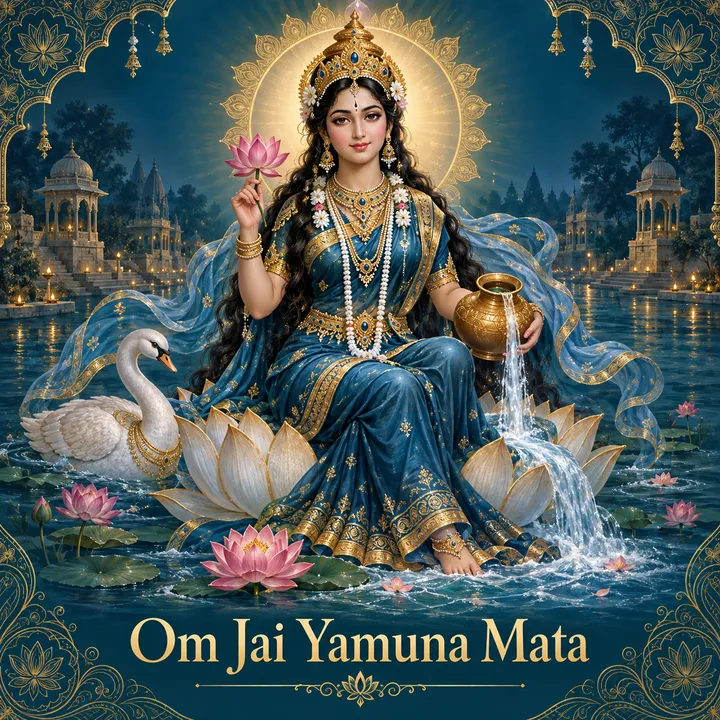
The text
Tap Recite along to follow verse by verse — use Next, or the arrow keys.
- Stanza 1 (refrain)
ॐ जय यमुना माता, हरि ॐ जय यमुना माता।जो नहावे फल पावे सुख दुःख की दाता॥
oṃ jaya yamunā mātā, hari oṃ jaya yamunā mātā।jo nahāve phala pāve sukha duḥkha kī dātā॥
Victory to Mother Yamuna, Hari Om, victory to Mother Yamuna. Whoever bathes in you receives its fruit — you grant joy and free us from sorrow.
- Stanza 2
पावन श्रीयमुना जल शीतल अगम बहै धारा।जो जन शरण में आया कर दिया निस्तारा॥ॐ जय यमुना माता, हरि ॐ जय यमुना माता।जो नहावे फल पावे सुख दुःख की दाता॥
pāvana śrī yamunā jala śītala agama bahai dhārā।jo jana śaraṇa mẽ āyā kara diyā nistārā॥oṃ jaya yamunā mātā, hari oṃ jaya yamunā mātā।jo nahāve phala pāve sukha duḥkha kī dātā॥
Your sacred Yamuna waters flow cool and unfathomably deep in their current; whoever comes to you for refuge, you carry safely across. Victory to Mother Yamuna, Hari Om, victory to Mother Yamuna. Whoever bathes in you receives its fruit — you grant joy and free us from sorrow.
- Stanza 3
जो जन प्रातः ही उठकर नित्य स्नान करे।यम के त्रास न पावे जो नित्य ध्यान करे॥ॐ जय यमुना माता, हरि ॐ जय यमुना माता।जो नहावे फल पावे सुख दुःख की दाता॥
jo jana prātaḥ hī uṭhakara nitya snāna kare।yama ke trāsa na pāve jo nitya dhyāna kare॥oṃ jaya yamunā mātā, hari oṃ jaya yamunā mātā।jo nahāve phala pāve sukha duḥkha kī dātā॥
Whoever rises at dawn to bathe in you daily, and meditates on you without fail, is freed from the fear of Yama, lord of death. Victory to Mother Yamuna, Hari Om, victory to Mother Yamuna. Whoever bathes in you receives its fruit — you grant joy and free us from sorrow.
- Stanza 4
कलिकाल में महिमा तुम्हारी अटल रही।तुम्हारा बड़ा महातम चारों वेद कही॥ॐ जय यमुना माता, हरि ॐ जय यमुना माता।जो नहावे फल पावे सुख दुःख की दाता॥
kalikāla mẽ mahimā tumhārī aṭala rahī।tumhārā baṛā mahātama cārõ veda kahī॥oṃ jaya yamunā mātā, hari oṃ jaya yamunā mātā।jo nahāve phala pāve sukha duḥkha kī dātā॥
In this age of Kali your glory remains unshaken; the four Vedas themselves proclaim your great greatness. Victory to Mother Yamuna, Hari Om, victory to Mother Yamuna. Whoever bathes in you receives its fruit — you grant joy and free us from sorrow.
- Stanza 5
आन तुम्हारे माता प्रभु अवतार लियो।नित्य निर्मल जल पीकर कंस को मार दियो॥ॐ जय यमुना माता, हरि ॐ जय यमुना माता।जो नहावे फल पावे सुख दुःख की दाता॥
āna tumhāre mātā prabhu avatāra liyo।nitya nirmala jala pīkara kaṃsa ko māra diyo॥oṃ jaya yamunā mātā, hari oṃ jaya yamunā mātā।jo nahāve phala pāve sukha duḥkha kī dātā॥
For your sake, Mother, the Lord took his incarnation; drinking your pure waters daily, he slew the tyrant Kansa. Victory to Mother Yamuna, Hari Om, victory to Mother Yamuna. Whoever bathes in you receives its fruit — you grant joy and free us from sorrow.
- Stanza 6
नमो मात भय हरणी शुभ मंगल करणी।मन बेचैन भया है तुम बिन वैतरणी॥ॐ जय यमुना माता, हरि ॐ जय यमुना माता।जो नहावे फल पावे सुख दुःख की दाता॥
namo māta bhaya haraṇī śubha maṅgala karaṇī।mana becaina bhayā hai tuma bina vaitaraṇī॥oṃ jaya yamunā mātā, hari oṃ jaya yamunā mātā।jo nahāve phala pāve sukha duḥkha kī dātā॥
Salutations, Mother, remover of fear and giver of auspiciousness; without you the soul grows restless before the river Vaitarani that the dead must cross. Victory to Mother Yamuna, Hari Om, victory to Mother Yamuna. Whoever bathes in you receives its fruit — you grant joy and free us from sorrow.
Overview
Om Jai Yamuna Mata is a Hindi aarti of six stanzas in praise of the river Yamuna, worshipped as a goddess and, in Vaishnava tradition, as Krishna’s constant companion on the banks of Braj. Each stanza is followed by the opening refrain, “Om jai Yamuna mata, hari Om jai Yamuna mata,” exactly as it is sung and printed today. It follows the same “Om jai [deity] mata” form widely used for river-goddess aartis, but its imagery is distinctly Yamuna’s own: the fear of Yama — her brother in Puranic genealogy — and the river Vaitarani that souls must cross after death.
Origin and source
Om Jai Yamuna Mata is an anonymous, traditionally transmitted composition. It was released as a studio recording by Shemaroo Bhakti in 2019 with the lyric credited simply as traditional, and it appears with the same six-stanza text and refrain across independent devotional lyrics publishers, including Drik Panchang’s lyrics archive. Minor wording variants exist between copies, typical of a text passed on through oral recitation and repeated hand-typesetting rather than a single fixed printed edition — for example, some copies read “sukha sampatti ki data” (giver of happiness and wealth) where others read “sukha duhkha ki data” (giver of joy, reliever of sorrow); this page follows the reading shared by the majority of the sources checked.
It is worth stating plainly that this is not the only Yamuna aarti in circulation. Printed devotional anthologies carry a separate, unrelated aarti to Yamuna, and at least one online lyrics page mislabels a reworded Ganga aarti as a Yamuna aarti. Om Jai Yamuna Mata is presented here as a distinct, independently and consistently attested composition in its own right — not as “the” definitive Yamuna aarti, since more than one genuinely exists in Hindu devotional literature.
Its verses draw on two threads of Puranic tradition: Yamuna as the daughter of the sun god Surya and the sister of Yama, lord of death, which grounds the aarti’s promise that bathing in and meditating on her removes the fear of Yama; and the Krishna tradition centered on Vrindavan and Mathura, where the infant Krishna is carried across the Yamuna and grows up on her banks before slaying the tyrant king Kansa.
How it is recited
Om Jai Yamuna Mata is sung in daily worship at Yamuna’s ghats in Mathura and Vrindavan, and in home and temple aartis elsewhere, with particular observance on Sundays, Tuesdays, and the full moon (purnima). It takes on special importance on Yamuna Jayanti, marking the river goddess’s descent to earth on the sixth day of the bright half of Chaitra, and on Yama Dwitiya — also kept as Bhai Dooj — the second day of the bright half of Kartik, when sisters honor their brothers, echoing Yamuna’s own bond with Yama in the aarti’s third stanza. As with other aartis, a lit lamp is offered toward an image of the goddess or toward the river itself while the refrain is repeated by everyone present after each stanza.
Frequently asked questions
How many verses does Om Jai Yamuna Mata have?
Who is Om Jai Yamuna Mata dedicated to?
When is Om Jai Yamuna Mata typically recited?
What language is Om Jai Yamuna Mata composed in?
What tradition is Om Jai Yamuna Mata associated with?
Is an English translation of Om Jai Yamuna Mata available?
Is there a Roman transliteration of Om Jai Yamuna Mata?
Sourcing
Checked against independent sources before publishing — see our sourcing and editorial policy. Spotted an error? Report an issue .

