Overview
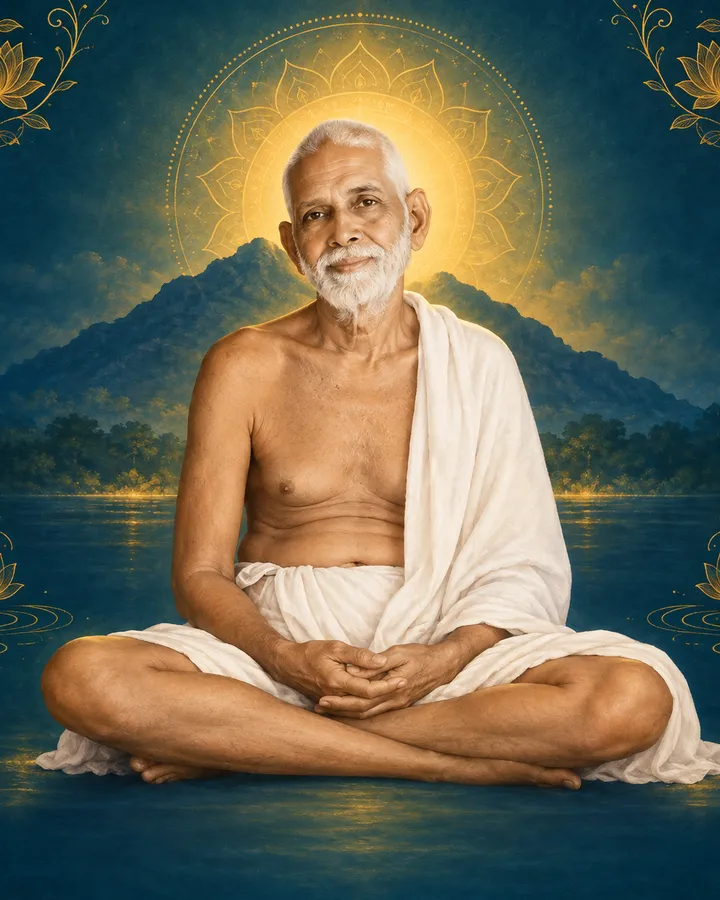
Ramana Maharshi was a South Indian sage who taught self-inquiry, atma-vichara, as a direct path to self-realization, based for the whole of his adult life at Arunachala hill in Tiruvannamalai, Tamil Nadu. Unlike most teachers in this tradition, he had no human guru — he regarded Arunachala itself as his guru, and his teaching authority rests entirely on his own spontaneous realization.
Awakening and arrival at Arunachala
Born Venkataraman Iyer at Tiruchuli, Tamil Nadu, he underwent a sudden and unsought experience at age sixteen: an intense fear of death that led him to ask directly “what dies?” — concluding, in the moment, that the body perishes but an underlying awareness does not. He described the realization that followed as immediate rather than gradually built up through practice. Within days he left home permanently, arriving at Tiruvannamalai on 1 September 1896, and remained there without interruption for the rest of his life, fifty-four years.
Self-inquiry
His central and essentially only teaching is self-inquiry: repeatedly asking “Who am I?” in order to trace the sense of “I” back to its source, offered as a direct practice rather than through ritual, devotional recitation, or formal yogic technique. This distinguishes his approach sharply from most of the bhakti- and ritual-centered traditions covered elsewhere on this site — his path is one of direct inquiry into the nature of the self rather than devotion to a deity or scripture.
Sri Ramanasramam and legacy
An ashram, Sri Ramanasramam, grew up organically around him beginning in 1922, after his mother’s death and burial at the site, and remains an active institution today, running meditation halls, a library, a hospital, and free medical camps. Paul Brunton’s 1934 book A Search in Secret India, following a 1931 visit, was significant in introducing him to audiences outside India, and he is widely cited as a major influence on later non-dual teaching, both within India and among Western teachers who trace their own approach back to his emphasis on direct self-inquiry. He died at the ashram in 1950; his tomb, alongside his mother’s, sits in the Samadhi Hall at the center of Sri Ramanasramam.
Worth knowing
- At age sixteen, in 1896, he underwent a sudden, spontaneous experience of intense fear of death that led him to inquire directly "what dies?" — concluding that the body perishes but an underlying awareness does not, a realization he described as immediate rather than gradually attained.
- He left home permanently within days of that experience and arrived at Tiruvannamalai on 1 September 1896, remaining there for the rest of his life, 54 years.
- His central teaching, self-inquiry (atma-vichara), consists of repeatedly asking "Who am I?" to trace the sense of "I" back to its source, offered as a direct practice rather than ritual, devotional recitation, or formal yogic technique.
- Sri Ramanasramam grew up around him beginning in 1922 and remains an active, functioning ashram today.
- Paul Brunton's 1934 book A Search in Secret India, following a 1931 visit, was significant in introducing him to Western audiences, and he is widely cited as a major influence on later non-dual teaching in both India and the West.