Overview
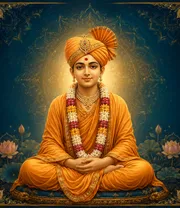
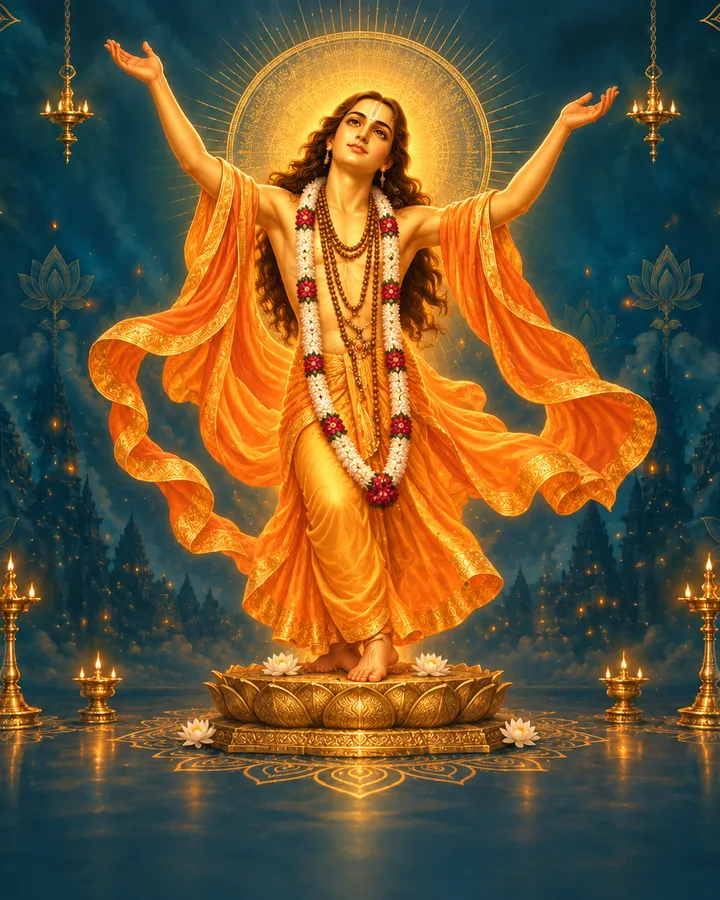
Chaitanya Mahaprabhu (चैतन्य महाप्रभु, Caitanya Mahāprabhu) was a 16th-century Bengali saint and the founder of Gaudiya Vaishnavism, a tradition of devotion to Krishna that holds Chaitanya himself to be a manifestation of the divine — a claim this page attributes to that tradition rather than states as settled fact, the same way it treats comparable claims made of Swaminarayan and Ramakrishna elsewhere on this site. He is best known for taking congregational chanting, sankirtan, of the Hare Krishna mantra into the public streets and town squares of Bengal, a practice with a direct historical line to the modern ISKCON movement.
Names and family
He was born Vishvambhara Mishra on 18 February 1486 in Nabadwip, in the Nadia district of Bengal, to Jagannatha Mishra and Sachi Devi. As a child he was called Nimai, said to come from the neem tree under which he was born; his fair complexion later earned him the name Gauranga, “golden-limbed,” and after taking formal renunciation he was known by the monastic name Sri Krishna Chaitanya. Biographical accounts also describe two marriages — to Lakshmipriya, said to have died of snakebite while he was away, and later to Vishnupriya — details drawn from hagiographic biography written after his death rather than independent historical record, and presented here as the tradition’s own account of his life.
Life
Before his renunciation, Chaitanya was known as a brilliant young Sanskrit scholar in Nabadwip, reportedly besting established scholars in debate. He received mantra initiation from his guru, Ishvara Puri, at Gaya around 1508 or 1509, a point tradition marks as the beginning of his devotional transformation, and took formal sannyasa at age 24, in 1510, at Katwa. He spent roughly the last two decades of his life based in Puri, Odisha, continuing to teach and undertake pilgrimage travel from there. Tradition also records that the local Muslim magistrate of Nabadwip initially opposed congregational chanting, and that Chaitanya led a large peaceful protest march in response, after which the opposition eased — a widely repeated episode from his biography, presented here with the same caution given to the rest of his life story rather than as independently verified history.
His death is usually dated to 1534 in Puri, though this page does not treat the date as beyond dispute, and its circumstances are genuinely unresolved: no physical remains or grave were ever found. Gaudiya Vaishnavism’s own account holds that he became mystically absorbed into the deity Jagannatha out of the intensity of his devotion; other, less devotionally framed accounts exist in secondary literature. This page does not assert any single explanation as settled.
Sankirtan and the Hare Krishna mantra
Chaitanya’s signature practice, and his most lasting historical legacy, was taking sankirtan — congregational, public chanting of the Hare Krishna mantra — out of scriptural study and private recitation and into the streets of Bengal, teaching that this chanting was, on its own, a complete spiritual practice for the present age. His disciples, particularly the group known as the Six Goswamis of Vrindavan, went on to systematize Gaudiya Vaishnava theology after him. That lineage runs directly to A. C. Bhaktivedanta Swami Prabhupada, who founded the International Society for Krishna Consciousness (ISKCON) in New York City in 1966, after which the mantra Chaitanya popularized reached a global audience for the first time.
In scripture
His own writing consists of a single short work, the Shikshashtakam, eight verses of devotional teaching. The fuller record of his life comes instead from biographies written by his followers: the Chaitanya Charitamrita, by Krishnadasa Kaviraja, regarded within Gaudiya Vaishnavism as the definitive account of his life and teaching, and the earlier Chaitanya Bhagavata, by Vrindavana Dasa. Gaura Purnima, observed on the full moon of the Hindu month Phalguna, marks his birth and remains the central festival of his commemoration today.
Parentage
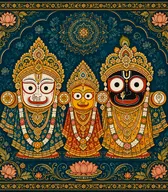 Father Jagannath Jagannatha Mishra Mother Sachi Devi
 Child Chaitanya Mahaprabhu
Iconography at a glance
Worth knowing
- Chaitanya Mahaprabhu was born Vishvambhara Mishra on 18 February 1486 in Nabadwip, Bengal, and is traditionally held to have died in Puri in 1534, though the exact date and circumstances of his death are genuinely disputed and not treated as settled here.
- He is credited with taking congregational chanting (sankirtan) of the Hare Krishna mantra into the streets and town squares of 16th-century Bengal, a practice this site's own page on that mantra also describes.
- Within Gaudiya Vaishnavism, he is held to be either an avatar of Krishna, or, in a further specifically Gaudiya development, a combined manifestation of Radha and Krishna in one body — a claim of his followers' tradition, not a fact this page asserts on its own.
- No physical remains or grave were ever found after his death; the tradition's own account holds that he became mystically absorbed into the deity Jagannatha out of the intensity of his devotion, though other accounts exist and this page does not treat any single one as settled history.
- His disciples, particularly the Six Goswamis of Vrindavan, systematized Gaudiya Vaishnava theology after him — a lineage that runs directly to A. C. Bhaktivedanta Swami Prabhupada, who founded ISKCON in New York City in 1966.